Your marketing team just claimed what your CER cannot support

A manufacturer launches a campaign claiming their device ‘significantly reduces recovery time.’ The clinical evaluation report mentions shorter recovery in one observational study with 40 patients. No statistical analysis. No comparative data. No defined endpoint. The Notified Body flags it immediately. This happens more often than it should.
In This Article
The gap between what marketing wants to say and what clinical evidence can actually support is one of the most persistent sources of regulatory deficiencies I see. It is not about marketing being dishonest. It is about a fundamental misunderstanding of what constitutes substantiation under MDR.
Marketing statements are not free speech. They are regulated claims that must be anchored in clinical evidence that has been evaluated, documented, and deemed sufficient by your clinical evaluation process.
What Makes a Statement a Claim
Not every sentence in your promotional material requires the same level of evidence. But determining what is simply descriptive and what crosses into a claim requiring substantiation is not always obvious.
A claim is any statement that asserts a characteristic, property, or effect of the device that goes beyond basic identification. If you say your device has five sensors, that is descriptive. If you say those sensors provide superior accuracy, that is a claim.
Under MDR Article 7, manufacturers must ensure that the information supplied with the device is consistent with the clinical evaluation. This is not a suggestion. It is a legal requirement. Every claim you make externally must be traceable to evidence assessed in your clinical evaluation report.
The burden is not on the Notified Body or competent authority to prove your claim is unsupported. The burden is on you to demonstrate that it is supported. If the link between claim and evidence is not clear in your documentation, the claim fails.
I have reviewed files where manufacturers assumed that because a claim appeared in a cited publication, it was automatically substantiated. That is not how it works. You must appraise that publication, assess its relevance and reliability, and explicitly connect its findings to your specific claim in your CER.
The Three Layers of Substantiation
Substantiating a clinical claim is not a single action. It is a process with three distinct layers, each of which must be addressed in your documentation.
Layer One: Evidence Exists
You must have clinical data that addresses the claim. This can be from your own clinical investigations, literature on equivalent devices, or post-market data. But it must exist, and it must be relevant.
Relevant means the study population, intended use, and clinical context align with your device and its application. A study on a different patient group or a different clinical setting does not automatically transfer.
Layer Two: Evidence is Appraised
Having evidence is not enough. You must critically appraise it. This means assessing study design, bias, sample size, statistical validity, and clinical relevance. The appraisal must be documented.
If you cite a study with significant methodological limitations, your CER must acknowledge those limitations and explain why the data is still sufficient to support the claim. Ignoring limitations does not make them disappear. Reviewers will find them.
Layer Three: Evidence is Sufficient
This is where most files fall short. Even good evidence may not be sufficient to support a strong marketing claim. A single feasibility study with 20 patients does not substantiate a claim of clinical superiority. A retrospective case series does not prove safety in high-risk populations.
Marketing claims are often written in absolute or comparative terms, but the supporting evidence is descriptive or observational. A claim that your device ‘improves patient outcomes’ requires comparative evidence. A single-arm study showing outcomes occurred is not the same thing.
The level of evidence required depends on the nature and strength of the claim. A claim of equivalence to a well-established device requires less evidence than a claim of superiority. A claim about a secondary outcome requires less evidence than a claim about a primary safety endpoint.
But in all cases, the evidence must be proportionate to the claim.
Where the Disconnect Happens
The breakdown usually occurs at the interface between departments. Marketing drafts materials based on internal beliefs, pilot data, or competitor positioning. Clinical and regulatory teams review those materials late in the process, often after they are already in production.
By that point, revising claims feels like an obstacle. Marketing pushes back. Timelines are tight. Compromises are made. The result is language that sounds reasonable but is not substantiated in your clinical evaluation.
I have seen files where the marketing brochure claims clinical benefits that are not mentioned anywhere in the CER. When asked, the manufacturer points to a single conference abstract or an ongoing study. That is not substantiation. That is a gap.
What makes this risky is that these disconnects are easy for reviewers to find. Notified Bodies and competent authorities routinely compare promotional materials to the CER during assessments. If they see a claim in your Instructions for Use or on your website that is not addressed in your clinical evaluation, it raises immediate questions about your quality management system and your understanding of MDR requirements.
The test is simple. For every claim you make externally, you should be able to open your CER, go to a specific section, and point to the evidence and analysis that supports it. If you cannot do that in under two minutes, the claim is not substantiated.
Common Types of Unsupported Claims
Certain types of claims appear repeatedly in deficiency letters because they are systematically under-substantiated. Recognizing these patterns helps you catch them before submission.
Comparative Claims Without Comparative Data
‘Better,’ ‘superior,’ ‘improved,’ ‘enhanced’—these words imply comparison. If your evidence base does not include head-to-head data or a robust indirect comparison, the claim is not supported.
This does not mean you can never make comparative claims. It means you need comparative evidence. A well-designed study comparing your device to standard of care can support these statements. A single-arm study cannot.
Safety Claims Based on Absence of Events
‘Safe,’ ‘well-tolerated,’ ‘minimal risk’—these claims require sufficient data to detect adverse events if they exist. A study with 30 patients and no complications does not prove safety. It proves you did not observe complications in 30 patients.
Safety claims must be proportionate to exposure. If you claim low complication rates, your dataset must be large enough to reliably estimate those rates and detect rare events.
Mechanism Claims Presented as Clinical Claims
‘Promotes healing,’ ‘enhances tissue regeneration,’ ‘optimizes cellular response’—these statements describe biological mechanisms. Unless you have clinical data showing that the mechanism translates into measurable patient benefit, these are hypotheses, not substantiated claims.
Bench testing and animal studies can support mechanism. But if you present mechanism as a clinical benefit, you need clinical evidence.
Durability and Long-Term Performance Claims
‘Long-lasting,’ ‘durable,’ ‘sustained benefit over time’—these claims require long-term data. If your longest follow-up is six months, you cannot claim long-term performance.
I see this often with implants and chronic-use devices. Marketing wants to claim durability, but the clinical data stops at one year. That is a gap.
Manufacturers sometimes argue that absence of complaints in post-market surveillance proves long-term performance. It does not. PMCF data can support durability claims, but only if the data collection is systematic, complete, and designed to capture the relevant endpoints.
Building a Substantiation Matrix
One practical tool that prevents these gaps is a claim substantiation matrix. This is a simple document that lists every claim made in your labeling, IFU, promotional materials, and website, and maps each claim to the specific section of your CER where it is substantiated.
The matrix should include the claim verbatim, the evidence source, the level of evidence, and any limitations or qualifications. If a cell is empty, the claim is not substantiated.
This is not a regulatory requirement, but it is a quality practice that makes your life easier. It forces alignment between clinical, regulatory, and marketing before materials are finalized. It gives your Notified Body a clear view of how you control claims. And it protects you during audits.
When a competent authority questions a claim, you can immediately show them the matrix, point to the evidence, and demonstrate that the claim was intentionally evaluated and approved.
What Substantiation Looks Like in Practice
Let me walk through an example. Suppose you manufacture a wound dressing and want to claim it ‘reduces healing time compared to standard gauze.’
Your CER must include a section dedicated to this claim. That section should summarize the comparative studies, describe the patient populations, present the healing time data with statistical analysis, acknowledge any limitations, and conclude whether the evidence is sufficient.
If your best evidence is a single randomized trial with 80 patients showing a statistically significant reduction in healing time, and the study quality is good, that may be sufficient. Your CER should say so explicitly.
If your evidence is two small observational studies with inconsistent results, that is not sufficient. Your CER should acknowledge the gap, and your marketing materials should not make the claim.
The substantiation is not just about having data. It is about having a documented evaluation that connects the data to the claim and concludes that the claim is justified.
If your clinical evaluation does not explicitly address a claim, it is not substantiated, even if the underlying data exists somewhere in your file. The substantiation must be documented and traceable.
Who Owns This Problem
Substantiation is not just a regulatory affairs task or a clinical affairs task. It is a cross-functional responsibility that requires coordination between marketing, clinical, regulatory, and quality.
Marketing must understand that claims are regulated and that creative language does not exempt them from evidence requirements. Clinical must ensure that the CER addresses every claim. Regulatory must review all external materials before release. Quality must enforce the process.
In practice, this means claims should be reviewed and approved before they are used, not after. Your QMS should include a procedure for claim approval that requires clinical and regulatory sign-off.
If a claim appears in your materials without going through that process, your system has failed.
What Happens When Claims Are Not Substantiated
The consequences are not theoretical. Unsupported claims lead to regulatory action. Notified Bodies issue non-conformities. Competent authorities send warning letters. In serious cases, certificates are suspended.
Beyond regulatory risk, unsupported claims create legal exposure. If a patient is harmed and your promotional materials overstated the evidence, that becomes part of the liability case.
And there is reputational risk. Reviewers remember manufacturers who repeatedly submit files with unsupported claims. It signals poor internal controls and lack of regulatory maturity.
The easiest way to avoid all of this is to align your claims with your evidence before you publish anything.
Moving Forward
Substantiation is not about limiting what you can say. It is about ensuring that what you say is defensible. Good evidence enables strong claims. Weak evidence does not.
The solution is not to avoid marketing. The solution is to generate the evidence that supports the claims you want to make, and to be honest about the claims your current evidence cannot support.
If your clinical data is limited, your claims should be limited. As you gather more data through PMCF and post-market studies, your claims can expand. That is how the system is supposed to work.
In the next part of this series, I will address how to handle claims when the evidence is evolving, and what to do when marketing and clinical cannot agree on what the data actually shows.
Until then, the principle is simple. Every claim must be substantiated. No exceptions.
– MDR 2017/745 Article 7: Information supplied by the manufacturer
– MDR 2017/745 Annex XIV: Clinical Evaluation and Post-Market Clinical Follow-up
Frequently Asked Questions
What is a Clinical Evaluation Report (CER)?
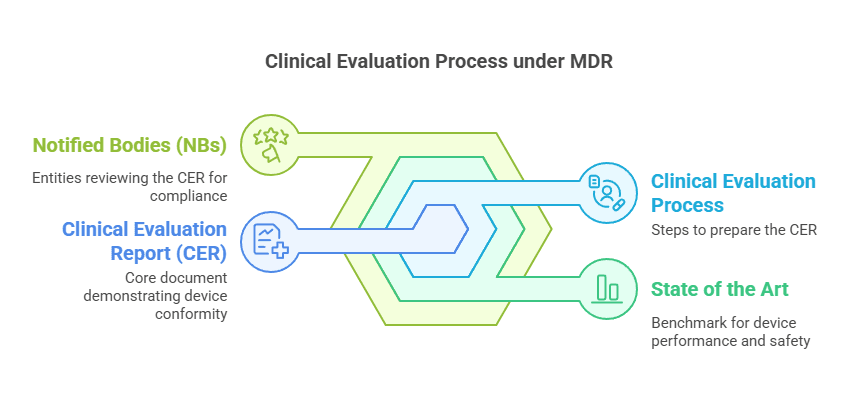
A CER is a mandatory document under MDR 2017/745 that demonstrates the safety and performance of a medical device through systematic analysis of clinical data. It must be updated throughout the device lifecycle based on PMCF findings.
How often should the CER be updated?
The CER should be updated whenever significant new clinical data becomes available, after PMCF activities, when there are changes to the device or intended purpose, and at minimum during annual reviews as part of post-market surveillance.
What causes CER rejection by Notified Bodies?
Common reasons include inadequate equivalence demonstration, insufficient clinical data for claims, poorly structured SOTA analysis, missing gap analysis, and lack of clear benefit-risk determination. Structure and logical flow are as important as the data itself.
Which MDCG guidance documents are most relevant for clinical evaluation?
Key documents include MDCG 2020-5 (Equivalence), MDCG 2020-6 (Sufficient Clinical Evidence), MDCG 2020-13 (CEAR Template), MDCG 2020-7 (PMCF Plan), and MDCG 2020-8 (PMCF Evaluation Report). MDR Article 7
Need Expert Help with Your Clinical Evaluation?
Get personalized guidance on MDR compliance, CER writing, and Notified Body preparation.
✌
Peace, Hatem
Your Clinical Evaluation Partner
Follow me for more insights and practical advice.
Deepen Your Knowledge
Read Complete Guide to Clinical Evaluation under EU MDR for a comprehensive overview of clinical evaluation under EU MDR 2017/745.