Your CAPA log doesn’t close because it never started right

I see manufacturers treat post-market clinical findings like isolated signals. A complaint comes in. A trend appears in PMCF data. Someone flags a literature report. The finding gets logged. An investigation starts. But the link between clinical evaluation and CAPA is broken from the beginning, and Notified Bodies see it immediately during audits.
The problem is not that manufacturers lack a CAPA process. Most have formal systems that comply with ISO 13485 requirements on paper. The problem is that clinical findings enter the quality system through the wrong door, or they enter correctly but get processed as if they were simple technical issues.
This creates a fundamental disconnect. Clinical evaluation identifies risks and benefits in a patient population context. CAPA manages corrective and preventive actions in a quality management context. When the translation between these two systems fails, you end up with corrective actions that do not address clinical risk, or clinical updates that never trigger the process improvements they should.
Let me walk you through what actually happens and why it keeps failing in real submissions.
The Entry Point Problem
Post-market clinical data arrives through multiple channels. Complaints. Vigilance reports. PMCF study results. Literature surveillance. Registry data. Clinical follow-up studies. These findings land in different departments and get handled by different people.
When a complaint describes a clinical event, it enters the complaint handling process. Someone investigates whether there was a device failure. If the device functioned as intended, the complaint often closes without further action. The clinical implication of that event never reaches the clinical evaluation team.
When a PMCF study reveals a higher-than-expected complication rate, the clinical team updates the CER. But the quality team does not receive a formal trigger to investigate whether manufacturing processes, labeling, or training materials need adjustment. The clinical finding stays inside the clinical file.
Clinical findings documented in the CER or PMCF report but never formally entered into the CAPA system. During audit, the Notified Body asks:
Frequently Asked Questions
What is a Clinical Evaluation Report (CER)?
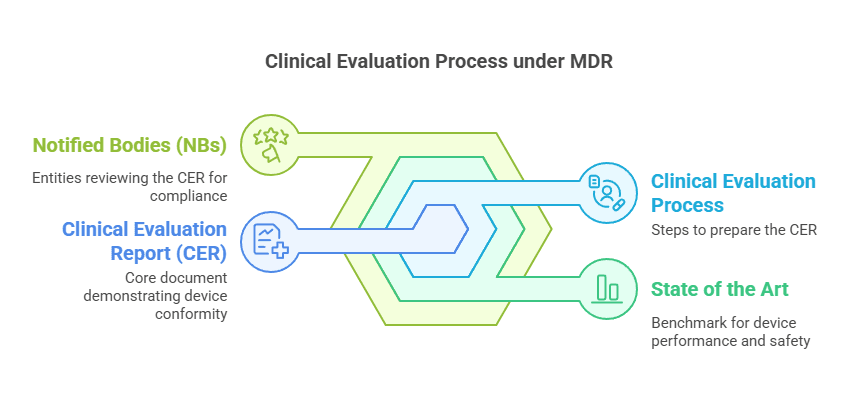
A CER is a mandatory document under MDR 2017/745 that demonstrates the safety and performance of a medical device through systematic analysis of clinical data. It must be updated throughout the device lifecycle based on PMCF findings.
How often should the CER be updated?
The CER should be updated whenever significant new clinical data becomes available, after PMCF activities, when there are changes to the device or intended purpose, and at minimum during annual reviews as part of post-market surveillance.
What causes CER rejection by Notified Bodies?
Common reasons include inadequate equivalence demonstration, insufficient clinical data for claims, poorly structured SOTA analysis, missing gap analysis, and lack of clear benefit-risk determination. Structure and logical flow are as important as the data itself.
Which MDCG guidance documents are most relevant for clinical evaluation?
Key documents include MDCG 2020-5 (Equivalence), MDCG 2020-6 (Sufficient Clinical Evidence), MDCG 2020-13 (CEAR Template), MDCG 2020-7 (PMCF Plan), and MDCG 2020-8 (PMCF Evaluation Report). ISO 13485, MDCG 2020-7
Need Expert Help with Your Clinical Evaluation?
Get personalized guidance on MDR compliance, CER writing, and Notified Body preparation.
✌
Peace, Hatem
Your Clinical Evaluation Partner
Follow me for more insights and practical advice.
Related Resources
Read our complete guide to CER under EU MDR: Clinical Evaluation Report (CER) under EU MDR
Or explore Complete Guide to Clinical Evaluation under EU MDR