Why Your Marketing Team Is Creating Clinical Evaluation Risk

A sales manager opens a brochure draft. Three bullet points claim faster healing, improved outcomes, reduced complications. She forwards it to regulatory for approval. Regulatory forwards it to me. I count six clinical claims. The CER covers two of them.
This is not an unusual situation. It happens in every company at every stage of maturity. Marketing develops content that sounds reasonable, commercial teams refine it to sound compelling, and then someone remembers that clinical evaluation might have an opinion about it.
By that point, launch timelines are locked, materials are designed, and sales training is scheduled. The expectation is that clinical will rubber-stamp the content and move on.
But MDR Article 7 does not operate on launch timelines.
The Regulatory Framework Nobody Wants to Read
Article 7 is titled
Frequently Asked Questions
What is a Clinical Evaluation Report (CER)?
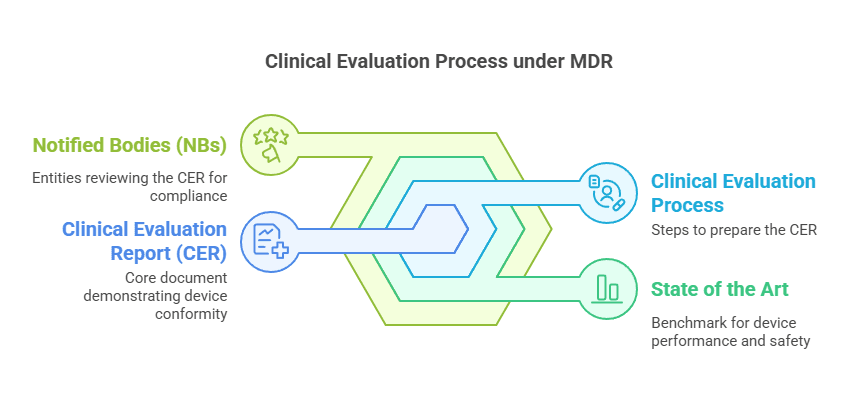
A CER is a mandatory document under MDR 2017/745 that demonstrates the safety and performance of a medical device through systematic analysis of clinical data. It must be updated throughout the device lifecycle based on PMCF findings.
How often should the CER be updated?
The CER should be updated whenever significant new clinical data becomes available, after PMCF activities, when there are changes to the device or intended purpose, and at minimum during annual reviews as part of post-market surveillance.
What causes CER rejection by Notified Bodies?
Common reasons include inadequate equivalence demonstration, insufficient clinical data for claims, poorly structured SOTA analysis, missing gap analysis, and lack of clear benefit-risk determination. Structure and logical flow are as important as the data itself.
Which MDCG guidance documents are most relevant for clinical evaluation?
Key documents include MDCG 2020-5 (Equivalence), MDCG 2020-6 (Sufficient Clinical Evidence), MDCG 2020-13 (CEAR Template), MDCG 2020-7 (PMCF Plan), and MDCG 2020-8 (PMCF Evaluation Report). MDR Article 7
Need Expert Help with Your Clinical Evaluation?
Get personalized guidance on MDR compliance, CER writing, and Notified Body preparation.
✌
Peace, Hatem
Your Clinical Evaluation Partner
Follow me for more insights and practical advice.
Where Marketing Claims Cross the Regulatory Line
Under EU MDR Article 7, clinical claims made in promotional materials must be substantiated by clinical evidence included in the Clinical Evaluation Report (CER). If your marketing team promotes a clinical benefit that is not supported by your clinical data, the Notified Body may issue a major non-conformity. This applies to website copy, brochures, trade show materials, and even social media posts.
Common violations include overstating device performance, using superlatives like “most effective” without comparative clinical data, and referencing clinical outcomes from non-equivalent devices. Regulatory authorities increasingly cross-reference marketing materials against technical documentation during market surveillance.
Building a Compliant Claims Management Process
Every clinical claim should go through a validation workflow before publication. This process should involve:
- A claims matrix linking each marketing statement to specific clinical evidence in the CER
- Regulatory review of all customer-facing materials before publication
- Clear distinction between intended purpose claims (regulated) and general product descriptions
- Regular audits of published marketing materials against the current state of clinical evidence
- Training for marketing teams on MDR Article 7 requirements and the consequences of non-compliance
Remember that MDR holds the manufacturer responsible for all claims made about the device, regardless of which department created them. A structured claims management process protects both the CE marking and the company from regulatory enforcement actions.
Real-World Examples of Marketing-Driven Regulatory Issues
Market surveillance authorities across Europe have increasingly focused on the alignment between marketing claims and clinical evidence. In 2024, several manufacturers received corrective action requests after their promotional websites made performance claims that exceeded the clinical data in their technical files. These cases resulted in forced website modifications, product recalls, and in some instances, suspension of CE certificates.
One common scenario involves marketing teams using clinical investigation results selectively, highlighting positive outcomes while omitting limitations or subgroup analyses that showed less favorable results. Under MDR Article 7, this selective presentation constitutes misleading information, even if the cited data is technically accurate.
Another frequent issue arises when marketing materials reference regulatory clearance in other jurisdictions (such as FDA 510(k)) as evidence of clinical performance in the EU. MDR requires independent clinical evaluation based on European standards and the specific intended purpose defined for the EU market. Regulatory approvals from other regions may support the body of evidence but cannot replace the structured clinical evaluation required under Annex XIV.
Deepen Your Knowledge
Read Complete Guide to Clinical Evaluation under EU MDR for a comprehensive overview of clinical evaluation under EU MDR 2017/745.