Why your EU CER might fail UK MHRA review

I reviewed a Class IIb device file last month that passed EU MDR certification without a single observation. The same file was submitted for UKCA marking. MHRA raised seven clinical evaluation deficiencies. Same device. Same CER. Different outcome. This is not an outlier. This is the new regulatory reality.
In This Article
Most manufacturers assume that EU MDR compliance automatically translates to UK compliance. The logic seems reasonable. Both frameworks share common ancestry. Both require clinical evaluation reports. Both reference essential performance and safety. But logic and regulatory reality do not always align.
What changes is not the concept of clinical evaluation. What changes is how evidence is assessed, what counts as sufficient, and where the burden of proof sits.
The structural divergence
EU MDR 2017/745 replaced the Medical Devices Directive in 2021. It introduced structured requirements for clinical evaluation under Article 61 and Annex XIV. MDCG guidance documents followed to clarify those requirements. The system is built around harmonized standards and a centralized regulatory philosophy.
The UK retained its Medical Devices Regulations 2002 post-Brexit. It was amended to maintain alignment with EU principles but operates under MHRA oversight. No MDCG. No centralized guidance pipeline. No automatic recognition of EU Notified Body decisions.
On paper, the clinical evaluation requirements look similar. Both demand a systematic appraisal of clinical data. Both require literature reviews, equivalence assessments when applicable, and clinical investigation data when equivalence cannot be established. Both require post-market surveillance integration.
But when you place a CER in front of an MHRA reviewer versus an EU Notified Body reviewer, the evaluation lens shifts.
The UK MDR 2002 framework does not reject EU MDR principles. It questions the sufficiency of evidence under a different review standard. What MHRA challenges is not the structure of your CER. It is whether your evidence actually proves what you claim it proves.
Where equivalence claims collapse
Equivalence is where most divergence surfaces. Under EU MDR Annex XIV Section 3, equivalence requires clinical, technical, and biological similarity. MDCG 2020-5 provides interpretation. The framework is strict but followable if you understand the logic.
MHRA applies the same logical structure but interrogates evidence differently. I see this pattern repeatedly. An equivalence table that satisfies an EU Notified Body gets challenged by MHRA on three fronts.
First, the technical comparison. EU reviewers often accept manufacturer declarations of technical similarity if supported by design files and test reports. MHRA reviewers want to see parameter-by-parameter justification with explicit risk consideration. They ask why differences in component material or manufacturing process do not alter clinical risk. If you cannot answer that with data, your equivalence claim weakens.
Second, the clinical data set for the equivalent device. EU Notified Bodies typically accept published literature plus manufacturer data if the equivalent device has sufficient market history. MHRA reviewers question whether that literature actually demonstrates safety and performance under conditions relevant to your intended use. They look for geographic match, user population match, and use environment match.
Third, the endpoint mapping. Your device and the equivalent device may share a mechanism of action. But do they share clinical endpoints? If your device is used in outpatient settings and the equivalent device data comes from hospital studies, MHRA will question generalizability.
Manufacturers submit the same equivalence table that passed EU review. MHRA rejects it because the evidence behind the table does not address post-market risk data for the equivalent device in the UK user environment. The table structure is fine. The evidence depth is insufficient.
Literature search and appraisal expectations
Both frameworks require systematic literature searches. Both expect PICO methodology and critical appraisal. The difference is in how completeness is judged.
Under EU MDR, a literature search that covers major databases, uses appropriate search terms, and follows MEDDEV 2.7/1 Rev 4 structure generally satisfies the requirement. If you explain exclusions and rate study quality, reviewers move forward.
MHRA reviewers dig into the search strategy itself. They want to see how you handled grey literature. They question whether your search term combinations might have excluded relevant studies. They look at the date range and ask why you did not extend it further back if early studies established foundational safety data.
They also apply a higher standard to study appraisal. A study rated as low quality in your CER might still be questioned if it reports an adverse event relevant to your device. MHRA wants to see how you addressed that event even if the study design was weak. Ignoring weak studies because they are weak is not sufficient. You must explain why the data they report does not alter your risk-benefit conclusion.
This creates a secondary burden. Your literature review must not only be systematic. It must also demonstrate that you considered every piece of data that a reasonable reviewer might find relevant.
State of the art analysis
EU MDR Article 61(1) requires that clinical evaluation confirms the device achieves its intended performance and that known and foreseeable risks are minimized when weighed against benefits. State of the art is implicit in that assessment but is rarely scrutinized as a standalone section.
MHRA treats state of the art as a distinct evaluative requirement. They expect a clear statement of what the current standard of care is, how your device compares to that standard, and what evidence supports your positioning.
If your device is a wound dressing, MHRA wants to see how it compares to other dressings in the same indication category. Not just in mechanism. In clinical outcomes. If published guidelines recommend a particular treatment pathway, your CER must address how your device fits or diverges from that pathway.
This is not just a data presentation issue. It is a reasoning issue. MHRA reviewers are assessing whether you understand the clinical context your device enters. If your state of the art section reads like a literature summary without comparative analysis, it will be flagged.
State of the art under MHRA review is not about listing alternative treatments. It is about demonstrating that your clinical evaluation considered how your device performs relative to those alternatives under real clinical conditions. If you cannot show that comparison, your benefit-risk conclusion lacks foundation.
Post-market clinical follow-up integration
Both frameworks require PMCF. Both require that PMCF findings feed back into the clinical evaluation. The divergence is in how that integration is demonstrated.
EU Notified Bodies typically review PMCF plans and PMCF evaluation reports as separate documents. As long as your CER references PMCF and your PMCF plan aligns with identified gaps, the connection is accepted.
MHRA reviewers expect explicit traceability. They want to see how specific PMCF objectives address specific uncertainties identified in your clinical evaluation. They want to see how PMCF data changes your risk-benefit assessment over time. They question static CERs that have not been updated despite years of post-market data.
This means your PMCF plan cannot be generic. It must be tied directly to clinical evaluation gaps. If your literature review identified limited data on long-term performance, your PMCF plan must include a method to collect that data. If MHRA sees a gap in your CER and no corresponding PMCF activity, they interpret that as incomplete risk management.
Clinical investigation expectations
When equivalence cannot be established, both frameworks require clinical investigation data. The threshold for when equivalence is insufficient is similar. The scrutiny applied to investigation design and execution differs.
EU Notified Bodies review clinical investigation reports against GCP and the investigation plan. If the study met its endpoints and was conducted properly, the data is accepted.
MHRA applies additional scrutiny to endpoint selection and relevance. They question whether the endpoints you chose actually measure clinical benefit in the intended use population. They look at whether your control group reflects real-world alternatives. They ask whether your follow-up period is sufficient to detect long-term risks.
I have seen investigation reports that passed EU review get challenged by MHRA because the primary endpoint was a surrogate measure rather than a direct clinical outcome. The data was valid. The conclusion drawn from the data was questioned.
Manufacturers assume that a completed clinical investigation satisfies all clinical evaluation requirements. MHRA challenges whether the investigation design actually answers the clinical questions that matter for the intended use. Completion is not the same as adequacy.
Practical implications for dual compliance
If you are preparing for both EU MDR and UK UKCA marking, you cannot simply duplicate your CER and submit it to MHRA. The content will be similar. The depth must be greater.
Your equivalence justification must include detailed technical analysis with explicit risk reasoning. Your literature review must address grey literature and explain every excluded study that might be relevant. Your state of the art section must include comparative effectiveness discussion. Your PMCF integration must show explicit traceability between gaps and activities.
This does not mean starting from scratch. It means anticipating MHRA questions and building answers into the structure of your CER. Every claim you make must be backed by data that directly supports that claim. Every gap you identify must be linked to a mitigation strategy.
The safest approach is to write your CER to MHRA expectations first. A CER that satisfies MHRA will satisfy EU Notified Bodies. The reverse is not always true.
What happens in practice
Most manufacturers discover these divergences during MHRA review. The first submission gets a list of clinical evaluation deficiencies. They revise and resubmit. The timeline extends. The cost increases.
The better path is to recognize the divergence upfront. Build your clinical evaluation strategy around the stricter standard. If you are working with both markets, align your CER development to MHRA expectations and adjust downward for EU if needed.
This is not about regulatory pessimism. This is about regulatory efficiency. One well-constructed CER that anticipates both review standards eliminates resubmission cycles and accelerates approval in both markets.
The divergence between UK MDR 2002 and EU MDR is not structural. It is interpretive. The framework is similar. The evidence expectations are higher. If you understand that distinction, you can prepare for it.
Peace,
Hatem
Clinical Evaluation Expert for Medical Devices
Follow me for more insights and practical advice.
Frequently Asked Questions
What is a Clinical Evaluation Report (CER)?
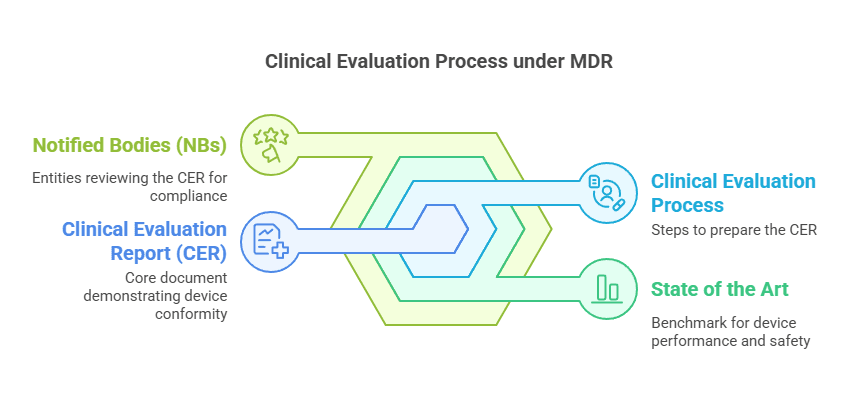
A CER is a mandatory document under MDR 2017/745 that demonstrates the safety and performance of a medical device through systematic analysis of clinical data. It must be updated throughout the device lifecycle based on PMCF findings.
How often should the CER be updated?
The CER should be updated whenever significant new clinical data becomes available, after PMCF activities, when there are changes to the device or intended purpose, and at minimum during annual reviews as part of post-market surveillance.
What causes CER rejection by Notified Bodies?
Common reasons include inadequate equivalence demonstration, insufficient clinical data for claims, poorly structured SOTA analysis, missing gap analysis, and lack of clear benefit-risk determination. Structure and logical flow are as important as the data itself.
Which MDCG guidance documents are most relevant for clinical evaluation?
Key documents include MDCG 2020-5 (Equivalence), MDCG 2020-6 (Sufficient Clinical Evidence), MDCG 2020-13 (CEAR Template), MDCG 2020-7 (PMCF Plan), and MDCG 2020-8 (PMCF Evaluation Report). UK MDR 2002
Need Expert Help with Your Clinical Evaluation?
Get personalized guidance on MDR compliance, CER writing, and Notified Body preparation.
✌
Peace, Hatem
Your Clinical Evaluation Partner
Follow me for more insights and practical advice.
– Regulation (EU) 2017/745 Article 61, Annex XIV
– UK Medical Devices Regulations 2002 (as amended)
– MEDDEV 2.7/1 Revision 4
– MDCG 2020-5 Equivalence Guidance
Deepen Your Knowledge
Read Complete Guide to Clinical Evaluation under EU MDR for a comprehensive overview of clinical evaluation under EU MDR 2017/745.