Why Your Equivalence Claim Was Never Valid

I’ve reviewed equivalence dossiers where manufacturers spent months documenting technical similarities, only to have the entire claim rejected in the first audit. The reason? They focused on proving the devices were similar, when MDCG 2020-5 asks a fundamentally different question: Can you actually demonstrate clinical equivalence?
In This Article
Most manufacturers approach equivalence as a technical exercise. They compare specifications, materials, and intended uses. They build comparison tables. They document every similarity.
Then the Notified Body or competent authority rejects the claim.
The problem isn’t the quality of the technical comparison. The problem is a fundamental misunderstanding of what MDCG 2020-5 actually requires.
What Equivalence Actually Means Under MDR
MDCG 2020-5 defines equivalence as a pathway to demonstrate sufficient clinical evidence by leveraging data from another device—the equivalent device. This is not about proving similarity. It’s about proving you can rely on someone else’s clinical data to support your device’s safety and performance.
The guidance is explicit: equivalence must be demonstrated across three dimensions—technical, biological, and clinical.
Here’s where the common interpretation fails.
Manufacturers focus almost exclusively on technical characteristics. They assume that if the devices are technically similar, clinical equivalence follows automatically. MDCG 2020-5 explicitly rejects this assumption.
Technical similarity is the starting point, not the conclusion. You must then demonstrate that these technical similarities translate into equivalent biological and clinical performance.
The Three Dimensions: What Each Actually Requires
Let’s break down what the guidance actually asks for in each dimension.
Technical Equivalence
Technical characteristics include design, specifications, materials, energy used, software, and manufacturing process. Most teams understand this dimension reasonably well.
But here’s what gets missed: you must demonstrate not just similarity, but that differences (because there are always differences) do not adversely affect clinical safety and performance.
I see tables listing similarities. I rarely see systematic analysis of differences and their clinical implications.
If your catheter has a slightly different coating, what does that mean for thrombogenicity? If your software version includes additional features, what does that mean for usability risks? These questions need answers with supporting evidence, not assertions.
Biological Equivalence
This is where equivalence claims start to break down.
Biological equivalence means the devices interact with the body in the same way. Same materials in contact with tissue, same duration of contact, same chemical characteristics, same degradation products if applicable.
The guidance requires you to demonstrate this through biocompatibility data, not through specification sheets.
If you’re claiming equivalence to a device with existing biocompatibility data, you need to show your materials and manufacturing processes result in the same biological interaction. ISO 10993 test reports are evidence. Material datasheets alone are not.
I’ve seen equivalence claims where the subject device used a slightly different grade of the same material. Same chemical composition on paper. Different supplier. Different processing. The manufacturer assumed biological equivalence.
The Notified Body requested biocompatibility testing to confirm. The assumption wasn’t enough.
Clinical Equivalence
This is the dimension most manufacturers underestimate.
Clinical equivalence means the devices have the same clinical use, are used under the same clinical conditions, and have the same intended clinical outcome. It also means the known risks and benefits are equivalent.
MDCG 2020-5 states clearly: technical and biological equivalence do not automatically imply clinical equivalence.
You must demonstrate it.
This requires analyzing the clinical data from the equivalent device and showing it’s applicable to your device given the technical and biological comparisons.
But here’s the critical requirement that almost everyone misses: you need access to detailed clinical data from the equivalent device, not just published summaries.
The Access to Data Problem
MDCG 2020-5 requires that you have full access to the clinical data from the equivalent device. Not published papers. Not summaries. Full data.
This means clinical evaluation reports, PMCF data, incident reports, and detailed clinical study data if applicable.
Why? Because you need to demonstrate that the clinical data supports your specific device, with its specific differences, in its specific intended use.
You can’t do that from a published abstract.
Equivalence claims based on literature data from competitor devices. The manufacturer doesn’t have access to the actual clinical dataset, only to published results. This doesn’t meet MDCG 2020-5 requirements for demonstrating equivalence.
In practice, this means equivalence is only truly viable in specific situations:
You’re comparing devices within your own product family where you control the clinical data. You have a formal agreement with another manufacturer giving you full access to their clinical data. You’re working with devices where comprehensive data is publicly available through regulatory submissions or detailed registries.
If you’re building an equivalence claim to a competitor device based on literature alone, you’re building on sand.
The Clinical Evaluation Report Implications
When you claim equivalence, your CER doesn’t get shorter. It gets more complex.
You must document the equivalence demonstration in detail. Every technical difference must be analyzed. Every material variation must be justified. Every clinical scenario must be covered.
Then you must present the clinical data from the equivalent device and explicitly connect it to your device.
I review CERs where equivalence is claimed in one paragraph, followed by a literature review that never mentions the equivalent device again. The connection isn’t made. The data isn’t integrated.
The reviewers notice.
Your CER must demonstrate equivalence, not declare it. Each section should show how the equivalent device data applies to your device considering the specific comparison. Generic literature reviews don’t fulfill this requirement.
You need to show that the safety data from the equivalent device applies to your device. That the performance data applies. That the benefit-risk profile applies.
This requires detailed analysis, not copy-paste from literature.
When Equivalence Actually Works
After pointing out all the ways equivalence claims fail, let me be clear: equivalence is a valid pathway when done correctly.
It works when you’re comparing versions within your own product line. It works when you have genuine data sharing agreements. It works when the devices are truly equivalent in all three dimensions and you can demonstrate it with evidence.
I’ve seen strong equivalence demonstrations where the manufacturer systematically addressed every requirement in MDCG 2020-5. They compared technical specifications with detailed rationale for differences. They provided biocompatibility data showing biological equivalence. They presented clinical data from the equivalent device with analysis showing applicability.
The Notified Body accepted the claim without major findings.
The difference wasn’t the devices. The difference was the rigor of the demonstration.
The Alternative Path
Here’s what most manufacturers don’t want to hear: sometimes generating your own clinical data is faster and more certain than trying to construct an equivalence claim.
If you don’t have full access to clinical data from a truly equivalent device, you’re going to struggle. The back-and-forth with reviewers, the additional justifications, the risk of ultimate rejection—it adds up.
A focused clinical investigation or a well-designed PMCF study might give you stronger evidence in less time.
Equivalence is a tool, not a shortcut. If the equivalence demonstration requires more work than generating direct clinical evidence, choose the path that gives you stronger, more defensible data.
I’m not saying avoid equivalence. I’m saying evaluate it realistically against MDCG 2020-5 requirements before committing to that pathway.
What This Means for Your Current Dossier
If you’re currently preparing or defending an equivalence claim, review it against the actual MDCG 2020-5 requirements.
Do you have full access to clinical data from the equivalent device? Can you demonstrate technical, biological, and clinical equivalence with objective evidence? Have you analyzed every difference and its clinical implications?
If the answer to any of these is uncertain, address it now. Don’t wait for the audit finding.
Equivalence claims that meet MDCG 2020-5 requirements get through review. Equivalence claims based on assumed similarity get challenged, delayed, or rejected.
The guidance tells you exactly what’s required. The question is whether you’re actually addressing those requirements or working from a simplified interpretation.
In the next part of this series, we’ll look at MDCG 2020-13 on clinical evaluation and how its requirements connect to the equivalence pathway.
Peace,
Hatem
Clinical Evaluation Expert for Medical Devices
Follow me for more insights and practical advice.
Frequently Asked Questions
What is a Clinical Evaluation Report (CER)?
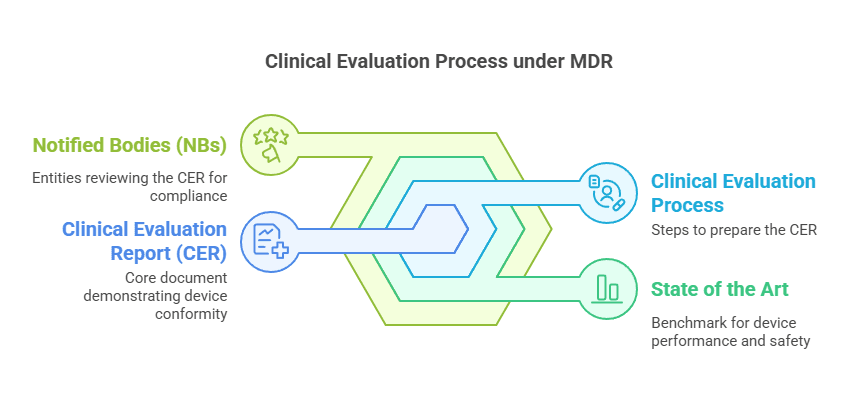
A CER is a mandatory document under MDR 2017/745 that demonstrates the safety and performance of a medical device through systematic analysis of clinical data. It must be updated throughout the device lifecycle based on PMCF findings.
How often should the CER be updated?
The CER should be updated whenever significant new clinical data becomes available, after PMCF activities, when there are changes to the device or intended purpose, and at minimum during annual reviews as part of post-market surveillance.
What causes CER rejection by Notified Bodies?
Common reasons include inadequate equivalence demonstration, insufficient clinical data for claims, poorly structured SOTA analysis, missing gap analysis, and lack of clear benefit-risk determination. Structure and logical flow are as important as the data itself.
Which MDCG guidance documents are most relevant for clinical evaluation?
Key documents include MDCG 2020-5 (Equivalence), MDCG 2020-6 (Sufficient Clinical Evidence), MDCG 2020-13 (CEAR Template), MDCG 2020-7 (PMCF Plan), and MDCG 2020-8 (PMCF Evaluation Report). MDCG 2020-5
Need Expert Help with Your Clinical Evaluation?
Get personalized guidance on MDR compliance, CER writing, and Notified Body preparation.
✌
Peace, Hatem
Your Clinical Evaluation Partner
Follow me for more insights and practical advice.
– Regulation (EU) 2017/745 (MDR), Annex XIV Part A
– MDCG 2020-5 Rev.1: Clinical evaluation – Equivalence
– MDCG 2020-6: Sufficient clinical evidence for legacy devices
Deepen Your Knowledge
Read Complete Guide to Clinical Evaluation under EU MDR for a comprehensive overview of clinical evaluation under EU MDR 2017/745.