Why your 510(k) data won’t pass MDR review

I reviewed a clinical evaluation last month where a manufacturer reused their FDA 510(k) substantial equivalence file for an MDR submission. The Notified Body stopped at page twelve. The problem was not missing data. The problem was that the entire evidence philosophy was incompatible with what MDR Article 61 requires.
In This Article
- The Core Philosophy: Equivalence Versus Performance
- What Counts as Clinical Evidence
- The Role of Literature in Each System
- The Depth of Clinical Data Required
- Post-Market Surveillance and Its Role in Evidence
- Documentation Standards and Traceability
- What This Means for Manufacturers With Both Submissions
- Final Thought
This happens more often than it should. Teams assume that regulatory approval in one market translates smoothly into another. It does not. The FDA 510(k) pathway and the MDR clinical evaluation process are built on fundamentally different philosophies about what constitutes sufficient evidence.
Understanding this difference is not academic. It determines whether your submission will pass or stall for months in deficiency loops.
The Core Philosophy: Equivalence Versus Performance
The 510(k) pathway is built on substantial equivalence. You demonstrate that your device is as safe and effective as a legally marketed predicate device. The comparison is central. If the predicate is accepted, and your device matches it in intended use, technological characteristics, and performance, you have your pathway.
MDR does not care about predicates.
Article 61 requires you to demonstrate conformity with the applicable general safety and performance requirements through clinical evidence. You must show that your device performs as intended and that the benefit-risk ratio is favorable under normal conditions of use. The comparison to another device is useful only if it supports that demonstration. It is not the foundation.
In the 510(k) world, equivalence is the goal. In the MDR world, equivalence is a tool. The goal is absolute demonstration of safety and performance.
This shift changes everything. Your evidence strategy, your literature search, your clinical data generation plan—all of it must align with this fundamental difference.
What Counts as Clinical Evidence
In a 510(k) submission, you often rely on bench testing, biocompatibility data, and a comparative table showing how your device matches the predicate. Clinical data may not be required if substantial equivalence is clear and the device type has a known risk profile.
Under MDR, clinical evidence is mandatory for all devices except low-risk Class I devices. Even when you use equivalence to support your evaluation, you must provide clinical data that demonstrates your device performs safely and effectively. MDCG 2020-5 makes this explicit. Equivalence alone does not satisfy the clinical evidence requirement.
I see teams try to shortcut this by pointing to the predicate’s clinical history. They write sections that say, “Device X has been on the market for fifteen years with no significant adverse events, and our device is equivalent to Device X, therefore our device is safe.”
Notified Bodies reject this reasoning immediately.
Relying on a predicate device’s clinical history without demonstrating clinical evidence specific to your device. MDR requires evidence that your device, not a similar device, meets safety and performance requirements.
The clinical evidence must tie back to your device. That evidence can come from literature, from post-market data, or from clinical investigations. But it must address your device’s performance in your intended patient population under your intended conditions of use.
The Role of Literature in Each System
In 510(k) submissions, literature is often used to support the predicate comparison or to address specific safety questions. The scope is narrow. You are not conducting a comprehensive appraisal of the clinical state of the art.
MDR flips this.
The clinical evaluation report must include a systematic literature review that establishes the current state of the art. You must identify relevant clinical data for equivalent or similar devices. You must appraise that data critically. You must demonstrate that your device’s benefit-risk profile is acceptable when measured against what is currently known in the field.
This is not a citation exercise. The literature review must be methodologically sound. Search strings, inclusion and exclusion criteria, appraisal methods—all of it must be documented and justified. MDCG 2020-13 provides the framework, and Notified Bodies audit it closely.
I have reviewed reports where the literature section was clearly copied from a 510(k) background section. Three or four references. No search methodology. No appraisal criteria. The team thought it was enough because it had been enough for FDA.
It was not enough.
The Depth of Clinical Data Required
Here is where the practical burden becomes clear.
A 510(k) submission might include a single clinical study if the predicate comparison is weak or if the device introduces new technological features. Often, no study is required. The equivalence argument carries the weight.
MDR assumes clinical data is necessary unless you can justify otherwise. For higher-risk devices, that data must be robust. Post-market data alone is rarely sufficient for a new device. You need clinical investigations or a very strong equivalence demonstration combined with extensive literature data.
Even when equivalence is used, MDCG 2020-5 sets strict criteria. The devices must have the same intended purpose, similar design and materials, similar biological interaction, and similar clinical performance. If any of these elements differ significantly, equivalence cannot be claimed, and you must generate clinical data specific to your device.
The bar for equivalence under MDR is higher than substantial equivalence under 510(k). Many devices that pass the 510(k) predicate comparison do not meet MDR equivalence criteria. When equivalence fails, clinical investigation is required.
This is where manufacturers hit the wall. They enter the MDR process expecting to reuse their 510(k) evidence package, and they discover that the evidence does not meet the MDR threshold. The gap can be six months to two years of additional work.
Post-Market Surveillance and Its Role in Evidence
In the 510(k) system, post-market surveillance is separate from the pre-market submission. You report adverse events. You may conduct post-market studies if FDA requests them. But the clinical evidence supporting clearance is locked at the time of submission.
MDR treats clinical evaluation as a continuous process.
Article 61 requires that clinical evaluation be updated throughout the lifecycle of the device. PMCF is not optional. It is a regulatory requirement for most devices. The PMCF plan must be outlined in the clinical evaluation report. The data collected through PMCF feeds back into the clinical evaluation, which is updated periodically.
This creates a dynamic evidence loop. Your initial clinical evaluation must include a plan for how you will continue gathering clinical evidence post-market. That plan must address gaps identified in the pre-market data. It must monitor long-term safety and performance. It must track rare adverse events and assess whether the benefit-risk profile remains favorable.
I see teams treat PMCF as a checkbox. They write generic plans with no connection to the actual clinical gaps in their evaluation. Notified Bodies see through this immediately.
PMCF plans that do not address specific clinical evidence gaps or uncertainties identified in the pre-market clinical evaluation. The plan must be targeted and justified based on the device’s risk profile and evidence limitations.
The PMCF plan must answer: What do we still need to know? How will we know it? When will we update the clinical evaluation with this data?
Without clear answers, the plan fails review.
Documentation Standards and Traceability
The 510(k) submission format is structured but flexible. You present your substantial equivalence argument. You provide supporting data. The narrative can be concise.
MDR clinical evaluation reports are formal, structured documents with specific content requirements. MEDDEV 2.7/1 Rev 4 defines the structure. Every claim must be supported. Every piece of data must be appraised. Every gap must be acknowledged and addressed through PMCF or risk mitigation.
The level of traceability is higher. When you state that your device meets a performance requirement, you must reference the data that supports that statement. When you claim equivalence, you must provide a detailed equivalence table with justifications for each criterion. When you appraise literature, you must document your methodology and explain why each study was included or excluded.
This is not bureaucracy. It is how Notified Bodies assess whether your clinical evaluation is scientifically sound and complete.
I have reviewed reports where the structure looked right, but the content was thin. Statements without references. Claims without data. The team had formatted the report correctly but had not filled it with the depth of evidence MDR requires.
Notified Bodies do not accept structure alone. They read the content. They trace every claim back to evidence. If the evidence is not there, the report fails.
What This Means for Manufacturers With Both Submissions
If you are preparing devices for both FDA and EU markets, you cannot build one submission and adapt it slightly for the other. The evidence strategies are different from the start.
Your 510(k) strategy focuses on demonstrating substantial equivalence efficiently. Your MDR strategy focuses on building a comprehensive clinical evidence base that demonstrates safety and performance absolutely, not just comparatively.
In practice, this means starting with the MDR requirements. If you build a clinical evaluation that satisfies MDR, you will have more than enough evidence to support a 510(k) submission. The reverse is not true. A 510(k) package rarely contains the depth and structure needed for MDR.
This is not about duplication of work. It is about strategic planning. Build the evidence base once, in a way that meets the higher standard, and extract what you need for each market.
Start with MDR requirements and scale down for 510(k). Starting with 510(k) and scaling up for MDR creates evidence gaps that are expensive and time-consuming to fill later.
The teams that manage this well plan their clinical development pathway with both markets in mind from the beginning. They conduct clinical investigations that satisfy MDR evidence requirements. They structure their literature reviews to meet MDCG 2020-13 standards. They design PMCF plans that meet MDR’s lifecycle evidence requirements.
The result is a unified evidence strategy that supports both submissions without redundant work.
Final Thought
The 510(k) and MDR pathways are not interchangeable. They reflect different regulatory philosophies about what evidence is sufficient to demonstrate that a medical device is safe and effective.
When you move between these systems, you must shift your approach to evidence. Equivalence is not the same as substantial equivalence. Literature review is not the same as background citations. PMCF is not the same as post-market reporting.
The manufacturers who succeed in both markets understand this early. They build clinical evidence strategies that meet the higher bar, and they plan their regulatory pathways accordingly.
In the next post, I will walk through how to structure a clinical evaluation report that satisfies MDR requirements without unnecessary complexity. The structure matters, but only if the content is sound.
Frequently Asked Questions
What is a Clinical Evaluation Report (CER)?
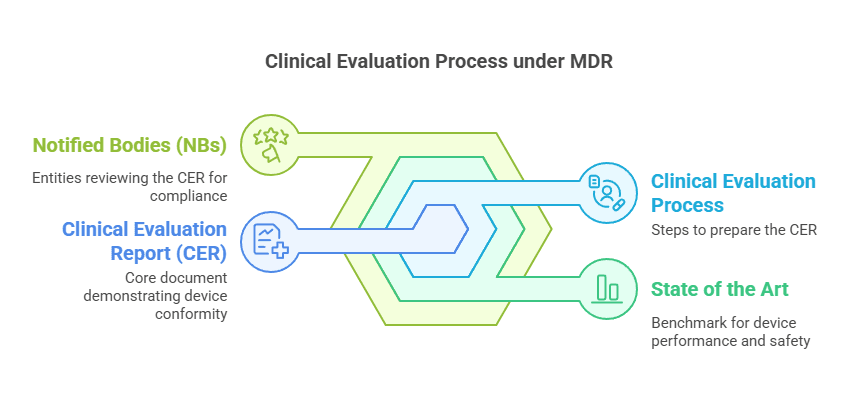
A CER is a mandatory document under MDR 2017/745 that demonstrates the safety and performance of a medical device through systematic analysis of clinical data. It must be updated throughout the device lifecycle based on PMCF findings.
How often should the CER be updated?
The CER should be updated whenever significant new clinical data becomes available, after PMCF activities, when there are changes to the device or intended purpose, and at minimum during annual reviews as part of post-market surveillance.
What causes CER rejection by Notified Bodies?
Common reasons include inadequate equivalence demonstration, insufficient clinical data for claims, poorly structured SOTA analysis, missing gap analysis, and lack of clear benefit-risk determination. Structure and logical flow are as important as the data itself.
Which MDCG guidance documents are most relevant for clinical evaluation?
Key documents include MDCG 2020-5 (Equivalence), MDCG 2020-6 (Sufficient Clinical Evidence), MDCG 2020-13 (CEAR Template), MDCG 2020-7 (PMCF Plan), and MDCG 2020-8 (PMCF Evaluation Report). MDR Article 61, FDA 21 CFR 807
Need Expert Help with Your Clinical Evaluation?
Get personalized guidance on MDR compliance, CER writing, and Notified Body preparation.
✌
Peace, Hatem
Your Clinical Evaluation Partner
Follow me for more insights and practical advice.
– Regulation (EU) 2017/745 (MDR) Article 61
– FDA 21 CFR 807 (Premarket Notification 510(k))
– MDCG 2020-5: Clinical evaluation equivalence guidance
– MDCG 2020-13: Clinical evaluation assessment framework
– MEDDEV 2.7/1 Rev 4: Clinical Evaluation Report structure
Deepen Your Knowledge
Read Complete Guide to Clinical Evaluation under EU MDR for a comprehensive overview of clinical evaluation under EU MDR 2017/745.