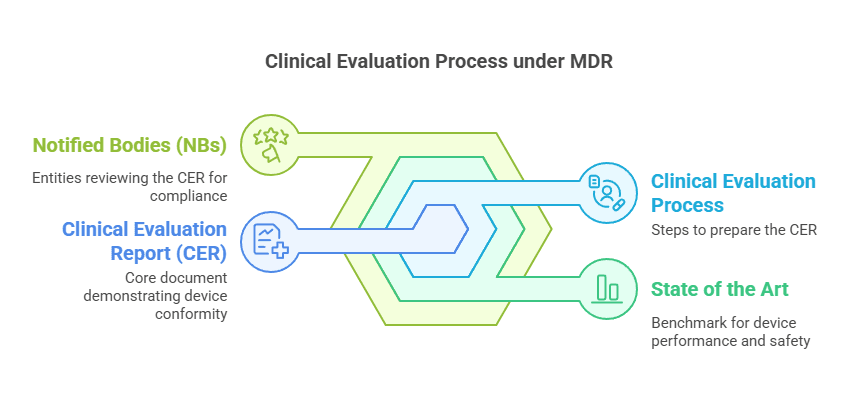
Why Active Implantable Device CERs Fail at First Submission

Most active implantable device manufacturers submit their Clinical Evaluation Report believing it meets MDR requirements. Then the Notified Body returns a 40-page deficiency list focused on clinical data gaps that should have been obvious from the start. The submission delay costs months, but the real issue runs deeper than missing studies.
In This Article
- The Regulatory Foundation That Teams Overlook
- What Makes Active Implantable Devices Different
- The Equivalence Trap for Implantable Devices
- What Clinical Evidence Actually Means Here
- The PMCF Integration Problem
- The State of the Art Benchmark
- How Clinical Data Gaps Get Addressed
- The Risk-Benefit Analysis Must Be Device-Specific
- What to Do Before Submission
- Final Considerations
I see this pattern repeatedly. The team prepares the CER. They cite literature. They present preclinical data. They claim equivalence or reference previous generations. The file goes to the Notified Body, and the response comes back: insufficient clinical evidence, inadequate risk-benefit analysis, unclear intended purpose boundaries, missing post-market data integration.
For active implantable devices under MDR, the regulatory threshold is not negotiable. These are Class III devices. Every aspect of the clinical evaluation must meet the highest standard of rigor. Yet many submissions treat the CER as a documentation exercise rather than a clinical reasoning exercise.
Let me walk you through what actually needs to happen, and why most submissions miss it.
The Regulatory Foundation That Teams Overlook
Active implantable devices fall under MDR 2017/745 and are specifically addressed in combination with the older AIMDD framework during the transition. Under MDR Article 61(4) and Annex XIV, the clinical evaluation must demonstrate safety and performance with a level of clinical evidence proportionate to the risk class.
For Class III devices, this means you cannot rely solely on literature. You cannot assume equivalence without rigorous justification. You cannot reference historical data without demonstrating its continued relevance.
The MDCG guidance documents, particularly MDCG 2020-5 on clinical evaluation, make this explicit. The appraisal of clinical data must address device-specific risks, patient populations, intended clinical benefits, and the current state of the art. For active implantable devices, the state of the art evolves rapidly. What was acceptable evidence five years ago may no longer be sufficient.
Manufacturers cite general literature on the therapy area without demonstrating that the specific device characteristics, parameters, or delivery mechanisms are adequately covered. The Notified Body asks: where is the evidence for your specific design and implementation?
This is where submissions fail. The evidence is generic. The reasoning is assumed. The clinical link between the device specifications and the clinical outcomes is not explicitly demonstrated.
What Makes Active Implantable Devices Different
Active implantable devices are not like other medical devices. They deliver therapy continuously or on demand. They remain in the body for extended periods. They interact with biological systems in ways that are dynamic and patient-specific.
This creates specific evaluation challenges:
Long-term performance cannot be inferred from short-term data. A device may function perfectly for six months and fail at eighteen months due to lead degradation, battery depletion patterns, or tissue response changes. The clinical evaluation must address how long-term safety and performance are established.
The patient cannot easily discontinue use. Unlike an external device, an implanted device requires surgical removal. Adverse events have higher consequences. The risk-benefit analysis must reflect this permanence.
Interactions with patient physiology are device-specific. Two pacemakers may both pace the heart, but differences in sensing algorithms, pacing thresholds, battery chemistry, or lead design create distinct clinical profiles. Equivalence claims often ignore these differences.
Notified Bodies understand this. They know that the clinical behaviour of an active implantable device is not generic. They expect the CER to address device-specific performance in detail.
The Equivalence Trap for Implantable Devices
Many manufacturers attempt to use equivalence routes for active implantable devices. They identify a predicate device. They claim similar technical and biological characteristics. They argue that clinical data from the predicate applies to their device.
This approach almost always generates major deficiencies.
Under MDR Annex XIV Section 3, equivalence requires that the devices are similar in clinical, technical, and biological characteristics. For active implantable devices, this bar is extremely high. Small technical differences create different clinical profiles.
Consider a neurostimulation device. The pulse width, frequency, amplitude, and electrode configuration all influence clinical outcomes and side effects. A device with different stimulation parameters is not equivalent, even if it targets the same anatomical site.
Battery technology matters. Hermetic seal design matters. Lead material composition matters. Sensing algorithms matter. Software control logic matters.
If you are claiming equivalence for an active implantable device, you must demonstrate not only that the specifications are similar, but that the clinical interactions and long-term behaviours are indistinguishable. This requires deep technical and clinical analysis, not a comparison table.
Most equivalence claims in the CER do not reach this depth. They compare specifications without analyzing clinical implications. The Notified Body sees this immediately.
What Clinical Evidence Actually Means Here
For active implantable devices, clinical evidence is not a collection of studies. It is a structured argument that links device characteristics to clinical outcomes through analyzed data.
The CER must answer specific questions:
What is the intended clinical benefit? Not just the intended purpose, but the actual clinical outcome the patient experiences. For a cardiac device, is it reduction in arrhythmic episodes? Improved quality of life? Reduced hospitalization? The benefit must be defined and measurable.
What are the device-specific risks? Generic risks like infection or lead displacement are not sufficient. What are the risks related to your specific design choices? What failure modes exist? What does the FMEA reveal about clinical consequences?
How does the device interact with patient variability? Patients differ in anatomy, disease state, comorbidities, and physiological response. How does the device perform across this variability? What subgroups may experience different outcomes?
What is the current state of the art? What do modern devices in this therapeutic area achieve? What are current clinical standards? How does your device compare? If your device underperforms relative to the state of the art, the risk-benefit may not be favorable.
These questions require data. Not just literature data, but data that specifically addresses your device.
The PMCF Integration Problem
For active implantable devices, post-market clinical follow-up is not optional. It is a regulatory requirement under MDR Article 61(11) and Annex XIV Part B.
Yet I see CERs submitted with PMCF plans that are vague, non-specific, or clearly templated. The plan lists generic objectives. It proposes surveys or literature reviews. It does not define how specific device performance parameters will be monitored over time.
This does not meet the standard.
The PMCF plan for an active implantable device must address long-term safety and performance. It must define clear clinical endpoints. It must specify how residual risks will be monitored. It must establish triggers for corrective action.
More importantly, the CER must integrate existing PMCF data if the device is already on the market. If you have post-market surveillance data, complaint data, or field performance data, it must be analyzed in the CER. If you do not include it, the Notified Body will ask why.
The CER references a PMCF plan but does not integrate any actual post-market data. The Notified Body questions whether the manufacturer is actually following the plan or whether the plan is just a document requirement.
If PMCF data exists, analyze it. If it reveals issues, address them. If it confirms safety and performance, present that confirmation with statistical rigor.
The State of the Art Benchmark
One of the most challenging requirements for active implantable devices is demonstrating that the device meets the current state of the art. This is required under MDR Article 2(43) and influences the risk-benefit determination.
State of the art is not what was acceptable when development started. It is not what competitor devices achieved five years ago. It is what is currently achievable in the field based on the latest scientific and technical knowledge.
For an active implantable device, this means comparing clinical performance against modern benchmarks. If current pacemakers achieve X% sensing accuracy and Y-year battery life, your device must meet or exceed these levels, or you must justify why different performance is acceptable.
This requires a structured state of the art analysis. You must identify current performance benchmarks. You must compare your device. You must address gaps.
Many CERs skip this analysis or present it superficially. The result is a deficiency asking for a complete state of the art evaluation.
How Clinical Data Gaps Get Addressed
Sometimes the clinical evidence simply does not exist. The device is novel. The patient population is rare. The intended use is not covered by existing studies.
This does not mean the submission fails. It means the CER must acknowledge the gap and define how it will be addressed.
If you are proposing a clinical investigation, the CER must explain why the investigation is necessary and how it will generate the required evidence. The investigation plan must be referenced and aligned with the evidence gaps.
If you are proposing PMCF as the evidence generation mechanism, the plan must be robust enough to actually generate clinical data. Generic follow-up surveys are not sufficient. You need defined endpoints, statistical power, and analysis methods.
The key is that the Notified Body must see a credible path to evidence. If the path is vague or unrealistic, the submission is delayed.
Acknowledging evidence gaps is not a weakness. It demonstrates understanding of the regulatory requirements and scientific rigor. What creates deficiencies is pretending the evidence exists when it does not, or proposing inadequate methods to fill the gaps.
The Risk-Benefit Analysis Must Be Device-Specific
The final component that often fails in active implantable device CERs is the risk-benefit analysis. This is not a general statement that benefits outweigh risks. It is a structured comparison of specific clinical benefits against specific device risks, supported by data.
Under MDR Annex I Section 1, the risk-benefit must be favorable when considering the state of the art and the intended clinical purpose. For Class III devices, this analysis must be explicit and quantitative where possible.
What does the device achieve? By how much? For what percentage of patients? With what adverse event rates? How does this compare to alternative treatments or no treatment?
These questions require data. If the data is not available, the risk-benefit cannot be established. If the risk-benefit is not established, the CER is insufficient.
I see many CERs that present a risk-benefit section with qualitative statements and no supporting analysis. This does not meet the MDR standard.
What to Do Before Submission
If you are preparing a CER for an active implantable device, the approach must be different from the start:
Begin with a clear definition of the clinical benefit. Define it in measurable terms. Identify what data is needed to demonstrate it.
Conduct a thorough gap analysis. What evidence exists? What is missing? How will gaps be filled?
Analyze device-specific risks in detail. Use FMEA. Use complaint data. Use field experience. Present the risks with clinical context.
Compare against the state of the art explicitly. Identify benchmarks. Show where your device stands. Justify any deviations.
Integrate all available clinical data, including post-market data. Do not treat the CER as a pre-market document if the device is already in use.
Ensure the PMCF plan is specific, measurable, and credible. Define endpoints. Define analysis methods. Define decision criteria.
If you approach the CER this way, the Notified Body sees a rigorous clinical reasoning process. The submission moves forward.
If you treat the CER as a template-driven documentation task, the deficiency list is predictable.
Final Considerations
Active implantable device clinical evaluation under MDR is not impossible. It is demanding. The regulatory expectations are high because the clinical risks are high and the devices are permanent.
The CER must reflect the complexity of the device and the clinical environment. It must demonstrate that safety and performance are established through rigorous evidence, not assumption.
Most deficiencies I see are not due to missing documents. They are due to insufficient clinical reasoning. The evidence is not analyzed deeply enough. The risks are not characterized specifically enough. The benefits are not quantified clearly enough.
The solution is not more documents. It is better clinical and regulatory thinking from the start.
Peace,
Hatem
Clinical Evaluation Expert for Medical Devices
Follow me for more insights and practical advice.
Frequently Asked Questions
What is a Clinical Evaluation Report (CER)?
A CER is a mandatory document under MDR 2017/745 that demonstrates the safety and performance of a medical device through systematic analysis of clinical data. It must be updated throughout the device lifecycle based on PMCF findings.
How often should the CER be updated?
The CER should be updated whenever significant new clinical data becomes available, after PMCF activities, when there are changes to the device or intended purpose, and at minimum during annual reviews as part of post-market surveillance.
What causes CER rejection by Notified Bodies?
Common reasons include inadequate equivalence demonstration, insufficient clinical data for claims, poorly structured SOTA analysis, missing gap analysis, and lack of clear benefit-risk determination. Structure and logical flow are as important as the data itself.
Which MDCG guidance documents are most relevant for clinical evaluation?
Key documents include MDCG 2020-5 (Equivalence), MDCG 2020-6 (Sufficient Clinical Evidence), MDCG 2020-13 (CEAR Template), MDCG 2020-7 (PMCF Plan), and MDCG 2020-8 (PMCF Evaluation Report).
Need Expert Help with Your Clinical Evaluation?
Get personalized guidance on MDR compliance, CER writing, and Notified Body preparation.
✌
Peace, Hatem
Your Clinical Evaluation Partner
Follow me for more insights and practical advice.
– MDR 2017/745 Article 61, Annex XIV
– MDR 2017/745 Article 2(43), Annex I Section 1
– MDCG 2020-5 Clinical Evaluation Assessment Report Template
– MDCG 2020-6 Regulation (EU) 2017/745: Sufficient Clinical Evidence for Legacy Devices
Deepen Your Knowledge
Read Complete Guide to Clinical Evaluation under EU MDR for a comprehensive overview of clinical evaluation under EU MDR 2017/745.