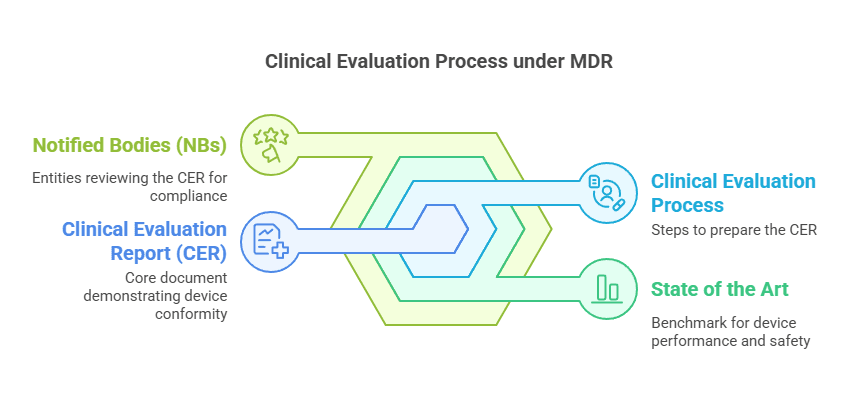
When Notified Bodies Request More Clinical Data

You submitted the clinical evaluation report. The technical documentation went to the Notified Body. Three months later, you receive feedback asking for additional clinical data. The question is simple: what do you change, and what do you defend?
In This Article
This is not a theoretical exercise. It happens in almost every review cycle. The Notified Body raises questions about your clinical evidence. They ask for more data, different studies, or additional analyses. The pressure is immediate. The timeline is at risk. And the team starts scrambling.
But not every request should lead to a change in your clinical evidence strategy. Some requests reveal legitimate gaps. Others reflect misunderstandings that you can clarify without altering the core documentation. Knowing the difference is critical.
Why Notified Bodies Request Additional Clinical Evidence
The request for more clinical data rarely comes out of nowhere. It reflects how the reviewer reads your documentation and applies the requirements of MDR Article 61 and Annex XIV.
The first reason is incomplete demonstration of equivalence. If you claimed equivalence to another device, the reviewer will look for evidence that the devices are truly equivalent in clinical, technical, and biological characteristics. If any element is weak or missing, the request comes back. This is not negotiable. MDCG 2020-5 is explicit about what equivalence requires.
The second reason is insufficient performance data for the intended purpose. The clinical evaluation must demonstrate that the device achieves its intended performance under normal conditions of use. If your literature search returned only surrogate endpoints, or if the population studied does not match your target users, the Notified Body will ask for more.
The third reason is inadequate analysis of residual risks. Even if you have clinical data, the reviewer needs to see that you evaluated how the data addresses the risks identified in your risk management file. If the connection is unclear, they will request bridging studies or additional post-market data.
Most requests for additional clinical evidence reflect structural gaps in how the clinical evaluation connects to risk management, intended purpose, or claims of equivalence. Rarely is it just about volume of data.
The First Step Is Not Changing Anything
When you receive the feedback, the instinct is to start gathering more studies or commissioning new clinical investigations. This is a mistake.
The first step is to read the deficiency carefully and map it back to your documentation. What exactly is the Notified Body questioning? Is it the quality of the data, the relevance of the data, or the interpretation of the data?
If the issue is quality, you may need different sources. If the issue is relevance, you may need to refine your search strategy or justify why your existing data applies. If the issue is interpretation, you can often resolve it with better reasoning in the clinical evaluation report without adding new studies.
I have seen teams add five new publications to a literature review when the real issue was that the original CER did not explain how the existing ten studies addressed a specific risk. The Notified Body was not asking for more data. They were asking for clearer logic.
Ask: Is This a Gap or a Clarity Problem?
A gap means you genuinely lack the evidence to support a claim or address a risk. A clarity problem means the evidence exists, but the connection between the evidence and the conclusion is not visible to the reviewer.
Clarity problems are resolved with better writing, cross-references, and structured reasoning. Gap problems require new data.
The distinction matters because changing your clinical evidence base has regulatory consequences. You may need to update the risk management file, revise the instructions for use, or adjust your PMCF plan. If you add data unnecessarily, you create downstream work that could have been avoided.
Teams often respond to every Notified Body question by adding more studies to the appendix, without first checking whether the original clinical evaluation adequately discussed the studies already included. Volume does not replace reasoning.
When You Must Change the Clinical Evidence
There are situations where you cannot resolve the deficiency with clarification. The evidence genuinely does not support the intended purpose, the target population, or the claims of safety and performance.
The most common scenario is when your device differs from the predicate device in a way that affects clinical outcomes. You claimed equivalence, but the Notified Body identified a technical difference that you did not adequately address. This happens frequently with software modifications, material changes, or new indications.
If the difference is significant, equivalence is no longer valid under MDCG 2020-5. You will need clinical data specific to your device. This could mean a clinical investigation, or it could mean a focused literature search on the specific feature that differs.
Another scenario is when your literature review returned insufficient data for a critical claim. For example, you claim your device reduces infection risk, but the studies you cited only measured surrogate markers, not actual infection rates. The Notified Body will ask for direct evidence. If that evidence does not exist in the literature, you may need to generate it.
The third scenario is when your risk analysis identified a significant risk, but your clinical evidence does not address it. The clinical evaluation must demonstrate that residual risks are acceptable when weighed against the clinical benefits. If the reviewer cannot trace how your data supports this conclusion, you will need targeted evidence.
What Changes Require Regulatory Notification
Adding new clinical data to your technical documentation is not automatically a substantial change under MDR Article 120. But it can be, depending on what the data reveals.
If the new data shows a different risk profile, or if it leads you to revise the intended purpose or contraindications, this may trigger a new conformity assessment. The Notified Body will evaluate whether the change affects safety or performance claims.
This is why you must assess the impact of new clinical evidence before you incorporate it. You cannot treat it as a simple appendix update. The clinical evaluation is the foundation for many other elements of your technical documentation.
When new clinical data changes your understanding of risks or benefits, it cascades through the entire technical file. Risk management, labeling, and PMCF plans must all align with the updated clinical evaluation.
How to Respond Without Overcommitting
The response you submit to the Notified Body is not just a formality. It sets expectations. If you commit to a clinical investigation, you are committing to a timeline, a protocol, and regulatory oversight of that study.
Before you commit, evaluate whether there is an alternative path. Can you refine your intended purpose to better match the available evidence? Can you adjust your claims to reflect what your data actually supports? Can you implement additional post-market surveillance to address uncertainty without delaying certification?
I have worked with manufacturers who proposed a two-year clinical study in response to a Notified Body question, when a targeted literature appraisal and a revised PMCF plan would have been sufficient. The difference is not just time. It is regulatory exposure.
Every commitment you make in your response will be tracked. If you promise a study and do not deliver it, the Notified Body will issue a non-conformity. If you promise interim data and the results contradict your claims, you may need to withdraw the device from the market.
The Role of the Clinical Evaluation Consultation Procedure
For certain high-risk devices and specific situations, the Notified Body may involve an expert panel under MDR Article 61(2). This happens when there is insufficient clinical evidence, or when the clinical evaluation raises questions about safety or performance.
If your case goes to the clinical evaluation consultation procedure, your response strategy must shift. The expert panel will review the clinical data independently. They will assess whether the evidence is adequate, and whether your benefit-risk analysis is credible.
At this stage, adding more low-quality data does not help. The panel will evaluate the strength of the evidence, not just the quantity. You need robust, directly relevant clinical data that clearly addresses the identified concerns.
Manufacturers sometimes submit a revised CER with ten additional studies, hoping to satisfy the Notified Body through volume. If the core concern was relevance or quality, this approach fails. The reviewer will simply identify the same gap in a larger appendix.
The Interaction Between CER Updates and PMCF
When you add clinical data in response to regulatory feedback, you must also consider your PMCF plan. The post-market clinical follow-up is designed to confirm the clinical evaluation conclusions and to detect emerging risks.
If you added new data because the original evidence was weak, the PMCF plan must include activities that validate this new data in real-world use. If you claimed equivalence and the Notified Body questioned it, your PMCF should collect data on the parameters that were disputed.
The Notified Body will check for consistency between your CER revisions and your PMCF plan. If you updated the clinical evaluation but did not adjust the PMCF activities, they will raise this as a deficiency.
This is not bureaucracy. It is logic. The clinical evaluation is a living document under MDR Article 61(11). The PMCF is the mechanism that keeps it alive. If the two are not aligned, your post-market surveillance system is incomplete.
What Happens When You Cannot Provide the Data
Sometimes the data does not exist. The device is novel. The intended population is small. The condition is rare. You conducted a literature search, but there are no directly relevant studies. You cannot conduct a clinical investigation because recruitment is not feasible.
This does not mean certification is impossible. But it changes the regulatory pathway. You will need to justify why the lack of data is acceptable, and you will need a robust PMCF plan that generates the missing evidence over time.
MDR Article 61(5) allows reliance on clinical experience and technical data when clinical investigations are not appropriate. But this exception is narrow. You must demonstrate that the device is similar to established devices, that the risks are well-understood, and that your PMCF will provide the necessary data.
The Notified Body will assess whether your justification is credible. If it is not, they will refuse certification until you generate the data. There is no workaround.
Regulatory feedback that asks for clinical data you cannot provide is a signal to reassess your regulatory strategy. Sometimes the answer is not more data. It is a revised intended purpose, a different risk classification, or a phased market entry.
Moving Forward
Regulatory feedback on clinical evidence is not an obstacle. It is information. It tells you how the Notified Body interprets your documentation and what they need to reach a conformity decision.
The goal is not to satisfy every request by adding data. The goal is to demonstrate that your clinical evaluation is sufficient under MDR requirements. Sometimes that requires new evidence. Sometimes it requires better reasoning. Sometimes it requires a change in your regulatory strategy.
What matters is that you respond with clarity, consistency, and a realistic plan that you can execute. The Notified Body is not looking for perfection. They are looking for adequacy and traceability. If your clinical evidence supports your claims, and if your reasoning is transparent, the certification will follow.
If it does not, that is also information. It tells you where your device stands in relation to regulatory expectations. And that is something you need to know before you go to market.
Peace,
Hatem
Clinical Evaluation Expert for Medical Devices
Follow me for more insights and practical advice.
Frequently Asked Questions
What is a Clinical Evaluation Report (CER)?
A CER is a mandatory document under MDR 2017/745 that demonstrates the safety and performance of a medical device through systematic analysis of clinical data. It must be updated throughout the device lifecycle based on PMCF findings.
How often should the CER be updated?
The CER should be updated whenever significant new clinical data becomes available, after PMCF activities, when there are changes to the device or intended purpose, and at minimum during annual reviews as part of post-market surveillance.
What causes CER rejection by Notified Bodies?
Common reasons include inadequate equivalence demonstration, insufficient clinical data for claims, poorly structured SOTA analysis, missing gap analysis, and lack of clear benefit-risk determination. Structure and logical flow are as important as the data itself.
Which MDCG guidance documents are most relevant for clinical evaluation?
Key documents include MDCG 2020-5 (Equivalence), MDCG 2020-6 (Sufficient Clinical Evidence), MDCG 2020-13 (CEAR Template), MDCG 2020-7 (PMCF Plan), and MDCG 2020-8 (PMCF Evaluation Report).
Need Expert Help with Your Clinical Evaluation?
Get personalized guidance on MDR compliance, CER writing, and Notified Body preparation.
✌
Peace, Hatem
Your Clinical Evaluation Partner
Follow me for more insights and practical advice.
– Regulation (EU) 2017/745 (MDR) Article 61, Article 120, Annex XIV
– MDCG 2020-5 Rev.1: Clinical Evaluation – Equivalence
– MDCG 2020-6: Sufficient Clinical Evidence for Legacy Devices
– MDCG 2020-13: Clinical Evaluation Assessment Report Template
Deepen Your Knowledge
Read Complete Guide to Clinical Evaluation under EU MDR for a comprehensive overview of clinical evaluation under EU MDR 2017/745.