When Great Britain Demands Its Own Clinical Data

A manufacturer cleared the EU with a clinical evaluation based on equivalence and literature. The device carried the CE mark. Then came UKCA preparation. The UK regulatory body raised a question that stopped everything:
In This Article
- The Regulatory Foundation: What Changed After Brexit
- When UK-Specific Clinical Investigations Become Mandatory
- The Problem With Assuming EU Data Transfers
- What UK-Specific Clinical Investigations Actually Look Like
- How to Assess Whether You Need a UK Study
- Alternatives and Mitigation Strategies
- What This Means for Your Compliance Strategy
This situation is playing out across multiple submissions right now. The assumption that clinical evidence accepted under MDR will automatically satisfy UK requirements is creating serious delays and compliance gaps.
The UK regulatory framework under UK MDR 2002 and subsequent amendments operates with its own logic. It aligns with many EU principles, but it applies them differently. And in certain cases, it explicitly requires clinical investigations conducted in Great Britain.
Understanding when UK-specific studies are required is not a theoretical exercise. It is a practical necessity that directly impacts timelines, budgets, and market access strategy.
The Regulatory Foundation: What Changed After Brexit
Before Brexit, a device with a CE mark had full access to the UK market. Clinical data generated anywhere in the EU was recognized. A single Notified Body assessment covered both territories.
That integration ended on January 1, 2021.
Now, the UK operates as a separate regulatory jurisdiction. The UKCA mark is required for devices placed on the Great Britain market. The MHRA acts as the competent authority. UK Approved Bodies replace EU Notified Bodies.
The clinical evaluation framework mirrors the structure of MDR 2017/745, but the UK applies its own interpretations and expectations. And in specific scenarios, the MHRA requires clinical evidence generated within Great Britain itself.
The UK regulatory system is not simply a copy of the EU system. It has retained discretion to apply different requirements, particularly regarding clinical investigations for higher-risk devices and novel technologies.
When UK-Specific Clinical Investigations Become Mandatory
The requirement for UK-generated clinical data is not universal. It is triggered by specific conditions.
First, device classification matters. Class III devices and implantable Class IIb devices face higher scrutiny. If the device represents a new technology or a significant modification of an existing device, the MHRA expects clinical investigation data that reflects the intended UK population and clinical practice.
Second, the nature of existing clinical evidence plays a role. If your clinical evaluation relies heavily on equivalence to another device, the MHRA will assess whether that equivalence holds under UK standards. If the equivalent device was not used in the UK, or if UK clinical practice differs meaningfully from the source country, the equivalence claim weakens.
Third, post-market data gaps trigger additional requirements. If your device has limited real-world use in Great Britain, the MHRA may require a UK-based clinical investigation as part of your PMCF strategy. This is especially common for devices where clinical outcomes are influenced by population characteristics, healthcare infrastructure, or clinical protocols that vary by region.
Manufacturers assume that if their device is widely used in Germany or France, this automatically covers the UK requirement. It does not. The MHRA evaluates whether the clinical data reflects the UK population, UK clinical standards, and UK healthcare context. Geographic diversity of data is not the same as UK-specific data.
Novel and Innovative Devices
If your device introduces a new mechanism of action, a new clinical indication, or a new patient population, the MHRA will not accept purely literature-based evaluations or equivalence claims.
In these cases, a clinical investigation is required. And increasingly, the MHRA expects at least part of that investigation to be conducted in Great Britain.
This is not arbitrary. Novel devices carry higher uncertainty. Regulatory bodies need data generated under conditions they can verify and trust. UK-based studies allow the MHRA to engage directly with investigators, review ethics committee approvals, and monitor study conduct through UK oversight mechanisms.
Significant Device Modifications
A significant change to an existing device can trigger the same requirement. If you modify the design, materials, intended use, or clinical claims of a device already on the market, the MHRA assesses whether existing clinical data still supports the modified version.
If the modification affects safety or performance in a meaningful way, new clinical data may be required. And if your device has limited UK post-market history, that new data must come from Great Britain.
The Problem With Assuming EU Data Transfers
Many manufacturers approach UK submissions with the mindset that clinical data accepted by an EU Notified Body will automatically satisfy the MHRA.
This assumption fails in practice.
The MHRA reviews clinical evaluations independently. It applies its own standards for scientific validity, clinical relevance, and population applicability. If your clinical data comes exclusively from patients treated in Poland, Italy, or Spain, the MHRA will question whether that data reflects UK patients, UK clinicians, and UK healthcare delivery.
This is not about nationalism. It is about scientific rigor. Clinical outcomes are influenced by genetics, comorbidities, treatment protocols, follow-up practices, and healthcare infrastructure. These factors vary across countries.
A surgical implant studied in a German university hospital may not perform the same way in a UK district general hospital. A diagnostic device calibrated for Mediterranean populations may yield different results in a Northern European population.
The MHRA does not reject EU clinical data outright. It evaluates whether that data is applicable to the UK context. If applicability cannot be demonstrated, UK-specific data becomes necessary.
What UK-Specific Clinical Investigations Actually Look Like
A UK clinical investigation must be conducted under UK regulations. This means compliance with UK MDR 2002, Good Clinical Practice standards, and MHRA oversight.
The investigation must be approved by a UK Research Ethics Committee. The investigational sites must be located in Great Britain. The investigators must be licensed to practice in the UK. Patient recruitment, informed consent, and adverse event reporting must follow UK legal and ethical standards.
The protocol must address the specific clinical question the MHRA has raised. If the concern is about applicability to UK patients, the study population must be representative. If the concern is about UK clinical practice, the protocol must reflect how the device will actually be used in NHS hospitals or private clinics.
Sample size matters. The MHRA will not accept a token study with 10 patients conducted at a single site as evidence of UK applicability. The study must be adequately powered to address the clinical endpoints that matter for your device.
Timing and Cost Implications
UK clinical investigations take time. Ethics review, site selection, contracting, patient recruitment, follow-up, and data analysis can easily extend 18 to 24 months. For devices requiring long-term follow-up, the timeline stretches further.
Costs are significant. UK investigators, NHS site fees, ethics applications, patient recruitment, and regulatory submissions add up quickly. Manufacturers who assumed their EU clinical data would suffice suddenly face unexpected budget impacts.
This is why early planning is critical. Waiting until the MHRA raises the question during submission review is too late.
How to Assess Whether You Need a UK Study
The decision should not wait until the MHRA tells you.
Start by reviewing your clinical evaluation critically. Ask: Does my clinical data include UK patients? Were any of my pivotal studies conducted at UK sites? Do my post-market data sources include UK users?
If the answer is no, assess the risk. Is your device high-risk? Is it novel or significantly modified? Does it rely on equivalence to a device with limited UK use? Are there population-specific factors that could affect performance?
If any of these conditions apply, assume the MHRA will raise the question. Plan accordingly.
Engage with your UK Approved Body early. They can provide insight into how the MHRA is likely to evaluate your clinical data. They can identify gaps before you submit.
Consider pre-submission meetings with the MHRA. These are not mandatory, but they can clarify expectations and prevent costly delays later.
Manufacturers submit UKCA applications assuming the MHRA will accept their existing clinical evaluation without modification. When the MHRA requests UK-specific data, they have no contingency plan. The submission stalls. The market access timeline collapses. This is avoidable with proper planning.
Alternatives and Mitigation Strategies
If a full UK clinical investigation is not feasible immediately, there are strategies to mitigate the gap.
One approach is to incorporate UK sites into ongoing or planned EU clinical studies. This generates UK-specific data without duplicating the entire study. It also demonstrates commitment to UK clinical evidence.
Another approach is structured PMCF in Great Britain. If your device is already on the UK market under transitional arrangements, a well-designed PMCF study can generate the real-world UK data the MHRA needs. This requires a robust protocol, systematic data collection, and clear clinical endpoints.
Registry participation is also valuable. If relevant UK clinical registries exist for your device type, contributing data and conducting subgroup analyses on UK patients strengthens your clinical evaluation.
None of these replace a formal clinical investigation when one is truly required. But they can support the argument that UK-specific data will be generated through other means, buying time and demonstrating regulatory commitment.
What This Means for Your Compliance Strategy
The UK market is not a simple extension of the EU anymore. It requires its own planning, its own data strategy, and its own regulatory engagement.
For manufacturers with high-risk or novel devices, assuming EU clinical data will suffice is a mistake. The MHRA has made clear that it will apply independent judgment. UK-specific clinical investigations are not rare exceptions. They are becoming standard expectations for certain device categories.
This does not mean every device needs a UK study. But it does mean every manufacturer must assess the risk and plan accordingly.
If your clinical evaluation relies entirely on non-UK data, if your device is new or significantly modified, or if your equivalence claim involves a device with no UK history, start planning now.
The question is not whether the MHRA will ask. The question is whether you will have an answer ready.
Peace,
Hatem
Clinical Evaluation Expert for Medical Devices
Follow me for more insights and practical advice.
Frequently Asked Questions
What is a Clinical Evaluation Report (CER)?
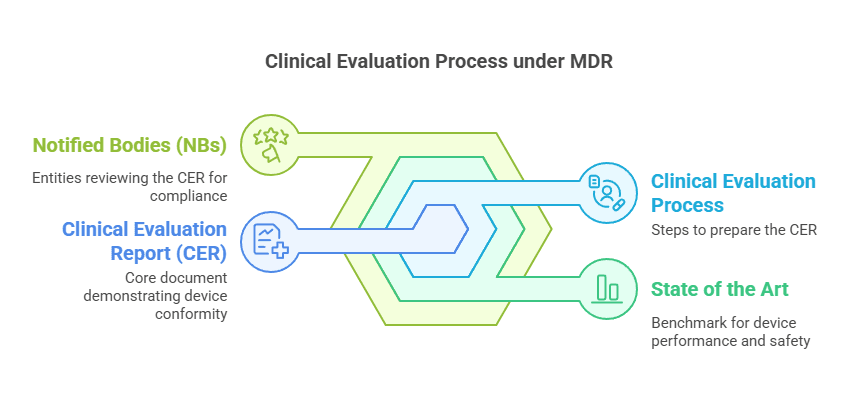
A CER is a mandatory document under MDR 2017/745 that demonstrates the safety and performance of a medical device through systematic analysis of clinical data. It must be updated throughout the device lifecycle based on PMCF findings.
How often should the CER be updated?
The CER should be updated whenever significant new clinical data becomes available, after PMCF activities, when there are changes to the device or intended purpose, and at minimum during annual reviews as part of post-market surveillance.
What causes CER rejection by Notified Bodies?
Common reasons include inadequate equivalence demonstration, insufficient clinical data for claims, poorly structured SOTA analysis, missing gap analysis, and lack of clear benefit-risk determination. Structure and logical flow are as important as the data itself.
Which MDCG guidance documents are most relevant for clinical evaluation?
Key documents include MDCG 2020-5 (Equivalence), MDCG 2020-6 (Sufficient Clinical Evidence), MDCG 2020-13 (CEAR Template), MDCG 2020-7 (PMCF Plan), and MDCG 2020-8 (PMCF Evaluation Report). UK MDR 2002
Need Expert Help with Your Clinical Evaluation?
Get personalized guidance on MDR compliance, CER writing, and Notified Body preparation.
✌
Peace, Hatem
Your Clinical Evaluation Partner
Follow me for more insights and practical advice.
– UK MDR 2002 (Medical Devices Regulations 2002, as amended)
– MHRA Guidance on Clinical Investigations
– UK Good Clinical Practice Standards
Deepen Your Knowledge
Read Complete Guide to Clinical Evaluation under EU MDR for a comprehensive overview of clinical evaluation under EU MDR 2017/745.