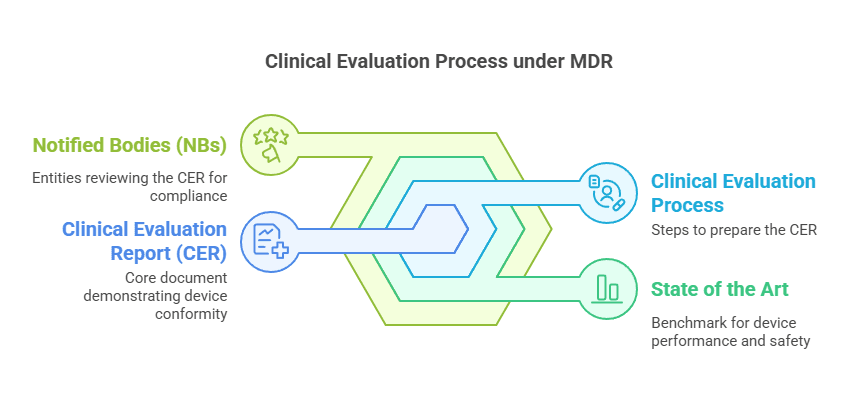
What really happens inside the CEAR process

Most manufacturers submit their technical file and wait. They assume silence means progress. Then, six months later, they receive a 40-point deficiency letter that questions the entire clinical foundation of their device. The CEAR process is not a passive queue. It is a structured review with decision gates, escalation points, and cumulative risk assessment. Understanding what happens inside that process changes how you prepare your submission.
In This Article
- The CEAR Is Not a Single Document Review
- Phase One: Initial Completeness Check
- Phase Two: Clinical Content Review
- Phase Three: Deficiency Generation and Response Review
- Phase Four: CEAR Drafting and Internal Review
- Phase Five: CEAR Issuance and Certificate Impact
- What This Means for Your Submission Strategy
The Clinical Evaluation Assessment Report (CEAR) is not just a procedural formality. It is the technical opinion that either validates or blocks your MDR compliance. It determines whether your clinical evaluation supports the safety and performance claims you are making under Article 61 of MDR 2017/745.
But here is the disconnect: manufacturers submit files as if the CEAR review is a single checkpoint. In reality, it is a multi-phase process with different reviewers, different decision points, and different triggers for rejection or escalation.
If you do not understand that structure, you will keep receiving the same types of deficiencies. You will keep revising without fixing the root issue. And you will extend your conformity assessment timeline by months.
The CEAR Is Not a Single Document Review
When you submit your technical file to a Notified Body, the clinical evaluation section enters a dedicated review process. That process involves clinical assessors, regulatory reviewers, and sometimes external experts. Each one looks at your file from a different angle.
The CEAR itself is the formal output of that review. It is the Notified Body’s independent assessment of whether your clinical evaluation meets MDR requirements. It addresses your device’s clinical safety, performance, benefit-risk profile, and the adequacy of your clinical data.
According to MDCG 2020-13, the CEAR must be based on the clinical evaluation report you provided, but it is not a passive endorsement. It is a critical appraisal. The assessor evaluates your methodology, your literature selection, your equivalence claims, your PMCF strategy, and your conclusions.
That appraisal can go three ways: acceptance, conditional acceptance with minor clarifications, or rejection with major deficiencies.
The CEAR is not a stamp of approval. It is an independent technical opinion. The Notified Body is required to challenge your clinical evaluation, not just accept it. If your CER cannot withstand that challenge, the CEAR will reflect it.
Phase One: Initial Completeness Check
Before any clinical review starts, the file goes through an administrative and structural completeness check. This is not about clinical content yet. It is about whether the submission contains all required sections under Annex II and Annex III of the MDR.
Reviewers verify that the clinical evaluation report is present, properly formatted, signed, and dated. They check that it includes all sections outlined in MEDDEV 2.7/1 Rev 4 or equivalent guidance. They confirm that referenced appendices, literature tables, and PMCF documents are actually included.
This phase takes one to three weeks depending on the Notified Body’s workload. If the file is incomplete, you receive an immediate request for missing documents. No clinical review begins until this is resolved.
Most manufacturers pass this phase. But I have seen files returned because the CER was not signed, the PMCF plan was referenced but not attached, or the State of the Art analysis was mentioned but missing.
This is the easiest phase to pass. And yet it delays many submissions.
Phase Two: Clinical Content Review
This is where the real assessment begins. A clinical assessor, often a medical doctor or clinical evaluation specialist, reviews your CER in detail.
They read your device description. They verify that it matches the intended purpose. They evaluate whether your scope of the clinical evaluation aligns with your claims. Then they analyze your clinical data selection, your appraisal methodology, and your conclusions.
The assessor is looking for gaps. They check whether your literature search was systematic and transparent. They verify that your inclusion and exclusion criteria were appropriate. They assess whether the clinical data you selected is actually relevant to your device.
If you claim equivalence, they scrutinize every element of your equivalence demonstration. They check whether the equivalent device is clearly identified, whether technical and biological equivalence are properly justified, and whether clinical equivalence is supported by data.
They also evaluate your State of the Art analysis. They assess whether you have identified current knowledge, accepted clinical practices, and relevant standards. They verify that your device aligns with that knowledge or, if it deviates, that the deviation is justified.
Then they look at your benefit-risk analysis. They check whether all relevant risks are considered, whether residual risks are acceptable, and whether clinical benefits outweigh those risks across all intended user groups and clinical indications.
Finally, they review your PMCF plan. They assess whether it addresses the gaps identified in your clinical evaluation, whether it includes appropriate methods and data sources, and whether it has defined timelines and responsibilities.
Manufacturers often submit a CER that is technically complete but clinically unconvincing. The sections are there. The tables are filled. But the reasoning is weak. The equivalence claim is vague. The SOTA is superficial. The benefit-risk conclusion is not supported by the data. This is what the clinical content review exposes.
This phase takes four to eight weeks for straightforward devices. For high-risk devices, devices with complex equivalence claims, or devices with limited clinical data, it can take three months or more.
Phase Three: Deficiency Generation and Response Review
If the clinical assessor identifies issues, they generate a deficiency list. This is not a rejection. It is a structured request for clarification, additional information, or revision.
Deficiencies can be minor or major. Minor deficiencies ask for clarifications, additional references, or editorial corrections. Major deficiencies question the validity of your clinical evidence, challenge your equivalence claim, or indicate that your PMCF plan does not address key uncertainties.
You receive the deficiency list and you have a defined timeframe to respond, typically 30 to 90 days depending on the severity and number of deficiencies.
Here is where many manufacturers make a mistake. They answer the questions superficially. They provide additional text but not additional substance. They revise the CER without re-evaluating the underlying clinical logic.
The Notified Body will review your response. If the response resolves the deficiencies, the clinical review progresses. If the response is insufficient, you receive a follow-up request or, in some cases, a non-conformity notice.
I have seen files go through three rounds of deficiencies because the manufacturer kept revising the same sections without addressing the root issue. Each round added two to three months to the timeline.
The solution is not faster answers. It is stronger clinical reasoning in the first submission.
Phase Four: CEAR Drafting and Internal Review
Once the clinical assessor is satisfied, they draft the CEAR. This document summarizes the review, describes the methodology used by the Notified Body, and presents the assessor’s conclusions on the adequacy of your clinical evaluation.
The CEAR includes an evaluation of each key element: device description and intended purpose, clinical data selection and appraisal, equivalence demonstration (if applicable), State of the Art analysis, benefit-risk determination, and PMCF adequacy.
It also includes a statement on whether the clinical evaluation supports the claims made in the instructions for use and the technical documentation.
Before the CEAR is finalized, it undergoes internal review within the Notified Body. A senior reviewer or clinical manager checks the assessor’s conclusions, verifies consistency with previous decisions, and ensures alignment with MDR requirements and internal procedures.
This internal review can surface additional questions. If the senior reviewer disagrees with a conclusion or identifies an overlooked issue, the CEAR goes back to the assessor for revision or further investigation.
This phase is invisible to the manufacturer. You do not receive updates during internal review. You only see the outcome once the CEAR is finalized.
This is why submission timelines are unpredictable. The clinical review may be complete, but the internal approval process can add weeks.
Phase Five: CEAR Issuance and Certificate Impact
Once the CEAR is finalized and approved, it is issued as part of the conformity assessment. The CEAR becomes part of the technical documentation reviewed during the certificate decision process.
If the CEAR concludes that your clinical evaluation is adequate, the clinical evaluation section is cleared for certificate issuance, assuming all other technical and quality management system requirements are met.
If the CEAR identifies unresolved issues or conditional acceptance with specific post-market commitments, those conditions are reflected in the certificate. You may receive a certificate with specific obligations, such as conducting additional clinical investigations, implementing enhanced PMCF activities, or submitting periodic updates.
In cases where the CEAR concludes that the clinical evaluation is insufficient and the deficiencies cannot be resolved through clarifications, the certificate application is rejected. You must revise your clinical evaluation, resubmit, and restart the CEAR process.
This is not common, but it happens. And when it happens, it is usually because the equivalence claim was fundamentally flawed, the clinical data was insufficient for the risk class, or the benefit-risk analysis did not support the intended use.
The CEAR does not just validate your clinical evaluation. It also sets expectations for your post-market activities. If your CER relies on gaps to be filled by PMCF, the CEAR will reflect that. If your equivalence claim depends on certain assumptions, the CEAR will note them. Those notes become audit points in your surveillance cycle.
What This Means for Your Submission Strategy
Understanding the CEAR process changes how you prepare your technical file. You stop writing the CER as a compliance document and start writing it as a defensible clinical argument.
You anticipate the clinical assessor’s questions before they are asked. You structure your equivalence demonstration so it can withstand scrutiny. You build your State of the Art analysis with current references and clear reasoning. You design your PMCF plan to address real uncertainties, not just check a regulatory box.
You also recognize that the CEAR process is iterative. Deficiencies are not failures. They are opportunities to strengthen your clinical evaluation before the certificate is issued.
But the most important shift is this: you stop waiting for the CEAR and start preparing for it during CER development.
Because by the time the deficiency list arrives, the timeline is already extended. The pressure is already high. And the room for structural revision is limited.
The manufacturers who move fastest through the CEAR process are not the ones who respond quickly to deficiencies. They are the ones who submit files that require minimal clarification because the clinical reasoning was sound from the start.
That is not about regulatory experience alone. It is about clinical rigor applied early in the documentation process.
Peace,
Hatem
Clinical Evaluation Expert for Medical Devices
Follow me for more insights and practical advice.
Frequently Asked Questions
What is a Clinical Evaluation Report (CER)?
A CER is a mandatory document under MDR 2017/745 that demonstrates the safety and performance of a medical device through systematic analysis of clinical data. It must be updated throughout the device lifecycle based on PMCF findings.
How often should the CER be updated?
The CER should be updated whenever significant new clinical data becomes available, after PMCF activities, when there are changes to the device or intended purpose, and at minimum during annual reviews as part of post-market surveillance.
What causes CER rejection by Notified Bodies?
Common reasons include inadequate equivalence demonstration, insufficient clinical data for claims, poorly structured SOTA analysis, missing gap analysis, and lack of clear benefit-risk determination. Structure and logical flow are as important as the data itself.
Which MDCG guidance documents are most relevant for clinical evaluation?
Key documents include MDCG 2020-5 (Equivalence), MDCG 2020-6 (Sufficient Clinical Evidence), MDCG 2020-13 (CEAR Template), MDCG 2020-7 (PMCF Plan), and MDCG 2020-8 (PMCF Evaluation Report).
Need Expert Help with Your Clinical Evaluation?
Get personalized guidance on MDR compliance, CER writing, and Notified Body preparation.
✌
Peace, Hatem
Your Clinical Evaluation Partner
Follow me for more insights and practical advice.
– MDR 2017/745 Article 61 (Clinical Evaluation)
– MDR 2017/745 Annex II and Annex III
– MDCG 2020-13 (Clinical Evaluation Assessment Report Template)
– MEDDEV 2.7/1 Rev 4 (Clinical Evaluation Guidelines)
Deepen Your Knowledge
Read Complete Guide to Clinical Evaluation under EU MDR for a comprehensive overview of clinical evaluation under EU MDR 2017/745.