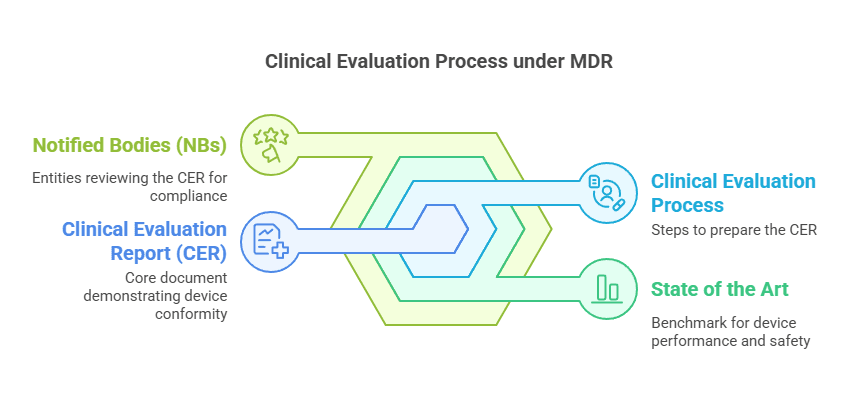
What most teams miss before their first NB clinical review

I have seen pre-submission meetings go two ways. Either the team comes prepared with clear clinical questions and leaves with direction, or they waste the slot asking vague questions and leave more confused than when they started. The difference is not the notified body. It is how you frame your clinical uncertainties before you walk in.
The pre-submission meeting is not a formality. It is not a courtesy call. It is the first moment where the notified body assesses whether your team understands what clinical evidence actually means under MDR.
Most manufacturers treat it like a sales pitch. They present the device. They talk about the innovation. They explain the market positioning. Then they ask:
Frequently Asked Questions
What is a Clinical Evaluation Report (CER)?
A CER is a mandatory document under MDR 2017/745 that demonstrates the safety and performance of a medical device through systematic analysis of clinical data. It must be updated throughout the device lifecycle based on PMCF findings.
How often should the CER be updated?
The CER should be updated whenever significant new clinical data becomes available, after PMCF activities, when there are changes to the device or intended purpose, and at minimum during annual reviews as part of post-market surveillance.
What causes CER rejection by Notified Bodies?
Common reasons include inadequate equivalence demonstration, insufficient clinical data for claims, poorly structured SOTA analysis, missing gap analysis, and lack of clear benefit-risk determination. Structure and logical flow are as important as the data itself.
Which MDCG guidance documents are most relevant for clinical evaluation?
Key documents include MDCG 2020-5 (Equivalence), MDCG 2020-6 (Sufficient Clinical Evidence), MDCG 2020-13 (CEAR Template), MDCG 2020-7 (PMCF Plan), and MDCG 2020-8 (PMCF Evaluation Report).
Need Expert Help with Your Clinical Evaluation?
Get personalized guidance on MDR compliance, CER writing, and Notified Body preparation.
✌
Peace, Hatem
Your Clinical Evaluation Partner
Follow me for more insights and practical advice.
Common Documentation Gaps That Trigger NB Deficiency Letters
Notified Bodies assess clinical evaluation documentation against Annex XIV of MDR 2017/745 and MDCG 2020-13. The most frequent deficiencies involve incomplete literature search protocols, missing PICO frameworks, and benefit-risk analyses that lack quantitative data. Teams that prepare only narrative summaries without structured appraisal tables often receive major findings.
A robust Clinical Evaluation Plan (CEP) must define the scope of the evaluation, equivalence justification (if applicable), and the acceptance criteria for clinical data. Many teams write the CEP after the CER, which reverses the intended logic and raises red flags during review.
How to Prepare for NB Clinical Review
Start by mapping your clinical evidence to each essential requirement in Annex I. For each claimed benefit, there must be traceable clinical data supporting it. Notified Bodies expect:
- A systematic literature search with reproducible methodology (databases, date ranges, search strings)
- An appraisal of each data source using predefined quality criteria
- A clear equivalence demonstration if relying on data from similar devices (Article 61(5))
- Post-market clinical follow-up (PMCF) integration showing how gaps will be addressed
- An updated benefit-risk analysis using current adverse event data from EUDAMED and vigilance reports
Teams that address these items proactively see significantly fewer deficiency letters. The key is treating clinical evaluation as a living process, not a one-time document exercise.
NB Review Timeline and What to Expect
A typical Notified Body clinical review cycle takes 60 to 120 days for the initial assessment. During this period, the NB clinical assessor evaluates the Clinical Evaluation Report (CER), the Clinical Evaluation Plan (CEP), the PMCF plan, and any supporting clinical investigation reports. Understanding the review stages helps teams manage expectations and prepare responses efficiently.
The first round of questions typically addresses fundamental gaps in the clinical evaluation methodology. The second round, if required, focuses on the adequacy of specific clinical data points and the completeness of the benefit-risk analysis. Teams that provide comprehensive, evidence-backed responses to first-round questions reduce the likelihood of a second review cycle.
Key tip: maintain a deficiency response tracker that maps each NB question to the specific section of your technical documentation where the answer is documented. This demonstrates traceability and accelerates the review process. Notified Bodies appreciate manufacturers who make their documentation easy to navigate with clear cross-references between the CER, risk management file, and PMCF plan.
Deepen Your Knowledge
Read Complete Guide to Clinical Evaluation under EU MDR for a comprehensive overview of clinical evaluation under EU MDR 2017/745.