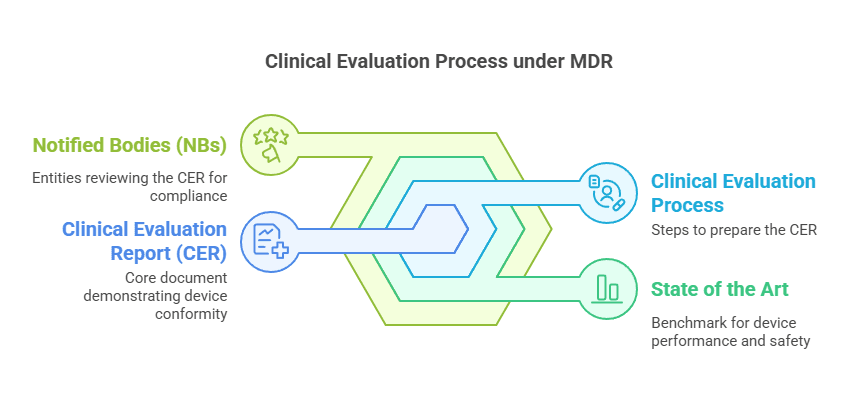
What Makes a CER Fail at Notified Body Review

Most CER deficiencies I see are not about missing data. They are about how the data is presented, analyzed, and connected to the device’s intended purpose. The structure tells the story. When the structure fails, the entire clinical evaluation fails with it.
In This Article
The Real Reason CERs Fail
When a Notified Body rejects a CER, the formal finding often points to “insufficient clinical evidence” or “inadequate equivalence demonstration.” These are the symptoms. The actual problem usually runs deeper.
In my experience reviewing hundreds of submissions, the root cause is almost always structural. The clinical data exists. The literature was searched. The device performs as intended. But the document fails to build a coherent argument that connects these elements to the regulatory requirements.
A CER is not a repository of clinical data. It is a structured argument demonstrating that the device meets essential requirements for safety and performance. Every section must serve this purpose.
This distinction matters. A data repository can be complete but still fail regulatory review. An argument, when properly constructed, leads the reviewer through your reasoning step by step.
Structure Deficiencies That Trigger Questions
Certain patterns in CER structure almost guarantee additional questions from reviewers. These are not formal deficiencies yet. They are warning signs that make reviewers look more closely.
Starting the SOTA chapter with a literature search methodology instead of a clear description of the current standard of care. Reviewers want to understand the clinical context first, then how you searched for evidence.
The device description is another frequent problem area. Many CERs describe what the device is without explaining what it does in clinical practice. Intended purpose needs to be stated in clinical terms, not marketing terms.
I often see equivalence sections that list technical specifications in tables without explaining their clinical relevance. A difference in coating thickness means nothing to the clinical evaluation unless you explain how it affects biocompatibility or performance.
Common CER Deficiency Categories
35%
28%
22%
15%
What Reviewers Actually Look For
Understanding the review process helps you anticipate questions. Notified Body reviewers follow MDCG 2020-13, but they also bring their own clinical and technical judgment to the assessment.
1. Clear Device Scope Definition
First, they check if the device scope is clearly defined. Can they understand exactly which device variants, indications, and patient populations the CER covers? Ambiguity here creates problems throughout the document.
2. Traceable Clinical Claims
Second, they trace the clinical claims back to the evidence. If you claim the device is safe for a specific indication, where is the data supporting that claim? The link must be explicit, not implied.
Reviewers are not trying to find problems. They are trying to understand your reasoning. Make it easy for them by being explicit about your logic and conclusions.
3. Honest Gap Analysis
Third, they evaluate the gap analysis. What questions remain unanswered after the clinical data analysis? How will PMCF address these gaps? A CER that claims no gaps exist is immediately suspect.
Building a Defensible Argument
The solution is not to add more data. It is to structure the existing data into a clear narrative.
Start with the clinical problem your device addresses. What is the current standard of care? What are its limitations? This establishes why your device exists and what clinical benefit it provides.
Then describe your device in terms of how it addresses those limitations. Technical specifications matter only insofar as they enable clinical function. Lead with clinical relevance.
The benefit-risk determination should feel inevitable by the time the reader reaches it. If you have built your argument correctly, the conclusion follows naturally from the evidence presented.
Clinical Evaluation Argument Structure
What This Means for Your Next Submission
Before submitting your CER, read it as a reviewer would. Can you trace every claim to its supporting evidence? Does each section logically follow from the previous one? Are there gaps in your reasoning that you have not acknowledged?
If you cannot answer these questions, neither can the Notified Body. And that is when deficiency letters arrive.
Frequently Asked Questions
What is a Clinical Evaluation Report (CER)?
A CER is a mandatory document under MDR 2017/745 that demonstrates the safety and performance of a medical device through systematic analysis of clinical data. It is part of the technical documentation and must be continuously updated throughout the device lifecycle.
What are the most common reasons for CER rejection?
The most common reasons include: inadequate equivalence demonstration (35%), insufficient State of the Art analysis (28%), lack of sufficient clinical data for claims (22%), and poor PMCF plan integration (15%). Often, the issue is structural rather than missing data.
How do I structure a CER that passes Notified Body review?
Build your CER as a logical argument, not just a data repository. Start with the clinical problem, describe the state of the art, explain how your device addresses limitations, analyze the evidence systematically, and reach a clear benefit-risk conclusion. Each section should prepare the reader for the next.
What does MDCG 2020-13 require for CER assessment?
MDCG 2020-13 provides the Clinical Evaluation Assessment Report (CEAR) template that Notified Bodies use to review CERs. It outlines the structure, content requirements, and assessment criteria for clinical evaluation documentation under MDR.
How often should a CER be updated?
The CER must be updated at least annually as part of PMS activities, after significant PMCF findings, when device modifications occur, following safety signals or incidents, and whenever new relevant clinical data becomes available.
Part 1 of 8
Your Clinical Evaluation Strategy Starts Before the First Sketch
Need Expert Help with Your Clinical Evaluation?
Get personalized guidance on MDR compliance, CER writing, and Notified Body preparation.
✌
Peace, Hatem
Your Clinical Evaluation Partner
Follow me for more insights and practical advice.
– MDR 2017/745 Article 61 and Annex XIV
– MDCG 2020-13 Clinical evaluation assessment report template
– MDCG 2020-6 Sufficient clinical evidence for legacy devices
Preventing NB review failures starts with understanding the full CER structure. Read our complete CER writing guide.
Deepen Your Knowledge
Read Complete Guide to Clinical Evaluation under EU MDR for a comprehensive overview of clinical evaluation under EU MDR 2017/745.