The gap between your PSUR and CER is a regulatory blind spot

I’ve reviewed submissions where the PSUR documented two field safety corrective actions, three trend shifts, and a complaint pattern that challenged a key clinical claim. The CER? Unchanged for 18 months. No linkage. No reflection. The manufacturer considered them separate documents. The Notified Body did not.
In This Article
This is not an isolated case. It is one of the most common structural deficiencies I encounter during CER reviews and pre-submission audits.
Most manufacturers understand that the Periodic Safety Update Report (PSUR) must summarize post-market surveillance data. Most understand that the Clinical Evaluation Report (CER) must remain current. But the workflow that connects them—the actual process of translating PSUR findings into CER updates—is often missing, informal, or delayed until an audit forces action.
This creates a gap. Not just a documentation gap. A reasoning gap. A gap that exposes clinical evaluation as reactive rather than continuous.
Why the PSUR-to-CER Link Matters Under MDR
The MDR makes clinical evaluation a continuous obligation. Article 61(11) requires manufacturers to update the CER throughout the lifecycle of the device. Annex XIV, Part A explicitly states that the clinical evaluation must be updated with data from post-market surveillance and post-market clinical follow-up.
The PSUR, required under Article 86, consolidates post-market data at defined intervals. It includes vigilance data, trend analysis, complaint patterns, emerging risks, and literature findings that were not available at the time of the last CER update.
MDCG 2020-7 and MDCG 2020-8 reinforce this connection. The clinical evaluation must integrate findings from the SSCP and PSUR. The PSUR is not just a summary for the competent authority. It is input for clinical re-evaluation.
But here is the problem: many organizations treat the PSUR as a compliance deliverable managed by post-market surveillance, and the CER as a technical document managed by regulatory affairs or clinical affairs. Different teams. Different timelines. Different priorities.
The result? PSUR findings sit in one folder. The CER sits in another. And the link between them is assumed, not executed.
The PSUR documents a shift in the clinical benefit-risk profile, but the CER clinical claims remain unchanged. When asked during audit how the PSUR influenced the CER, the answer is often vague or defensive.
What the Workflow Should Look Like
The workflow is not complex. But it must be formalized, documented, and consistently applied.
First, the PSUR must be written as if it will inform the CER. Not just as a regulatory summary. This means the PSUR conclusion section should explicitly identify findings that challenge or confirm clinical claims, safety assumptions, or benefit-risk conclusions.
Second, once the PSUR is finalized, a formal review must be triggered. This is not a passive step. It is an active decision point: do the PSUR findings require a CER update?
If the answer is yes, the CER must be revised. Not next year. Not at the next periodic review. Now.
If the answer is no, that decision must be documented with reasoning. Why do the findings not require an update? That justification itself becomes part of the traceability.
Third, the updated CER must reference the PSUR by identifier and date. The clinical evaluation must show that it considered the post-market data. The rationale for maintaining or revising clinical conclusions must be explicit.
The link between PSUR and CER is not automatic. It requires a documented decision point, clear responsibility, and traceability in both documents.
What Triggers a CER Update
Not every PSUR requires a CER update. But certain findings always do.
If the PSUR identifies a new risk or a shift in the frequency or severity of a known risk, the clinical evaluation must be updated. The safety profile has changed. The benefit-risk balance may have shifted.
If the PSUR documents field safety corrective actions, the CER must reflect the root cause analysis, the implications for clinical use, and any revision to instructions for use or contraindications.
If the PSUR identifies a complaint trend that challenges a clinical claim—such as device underperformance in a specific patient subgroup—the CER must address it. Either by confirming the claim with additional data or by revising the claim.
If the PSUR includes new clinical literature that contradicts the state of the art analysis or the equivalence demonstration, the CER must be updated to integrate or refute that literature.
And if the PSUR identifies gaps in clinical data or performance data, the PMCF plan must be revised, and the CER must acknowledge the gap.
These are not theoretical triggers. These are the findings I see in real PSURs. And too often, they do not lead to CER updates until the next scheduled review—or until a Notified Body raises the issue.
The PSUR mentions a complaint trend. The CER does not. When asked, the manufacturer says the trend was investigated and found acceptable. But that reasoning is not documented in the CER, and the Notified Body cannot verify continuity of clinical evaluation.
Traceability Is the Real Test
Auditors and Notified Bodies do not just check whether the PSUR and CER exist. They check whether they are connected.
They will open the PSUR and identify key findings. Then they will open the CER and look for how those findings were addressed. If the connection is not visible, the clinical evaluation is not considered continuous.
This is why traceability must be explicit. The CER should have a section or annex that lists PSUR findings and how they were evaluated. Not as a summary. As a decision log.
For example: PSUR 2023-001 identified increased complaints related to connector detachment in humid environments. Clinical evaluation reviewed complaint data and root cause analysis. No safety risk identified. Instructions for use already include storage conditions. No CER revision required. Decision documented on [date] by [role].
That level of documentation shows continuity. It shows that the manufacturer is not passively collecting data. It shows active evaluation.
And if a CER update is required, the revision history should reference the PSUR that triggered it. Version control is not administrative. It is clinical reasoning made visible.
Traceability between PSUR and CER is not optional documentation. It is the evidence that clinical evaluation is continuous, not periodic.
The Organizational Reality
In most organizations, the post-market surveillance team prepares the PSUR. The clinical affairs or regulatory affairs team manages the CER. These teams may sit in different departments. They may report to different managers. They may have different priorities and deadlines.
This is where the workflow breaks down.
The post-market team finalizes the PSUR and uploads it to the document management system. They may inform regulatory affairs by email or in a meeting. But there is no formal handoff. No clear responsibility. No documented trigger.
Months later, during a Notified Body audit, the reviewer asks how the PSUR findings were reflected in the CER. The regulatory affairs team was not aware that an update was needed. The clinical evaluation looks outdated.
The solution is not more communication. The solution is a documented procedure that defines the handoff, the review, and the decision point.
This procedure should specify who reviews the PSUR for clinical implications, who decides whether a CER update is needed, who performs the update, and who approves the decision. It should include timelines. And it should be part of the quality management system.
Without this, the link between PSUR and CER remains informal. And informal processes do not survive audits.
What Happens When the Link Is Missing
The consequences are not always immediate. But they accumulate.
First, the CER becomes less credible. If it does not reflect current post-market data, reviewers question whether the manufacturer is actively monitoring the clinical performance and safety of the device.
Second, the benefit-risk analysis becomes unreliable. If risks identified in the PSUR are not integrated into the CER, the clinical evaluation does not represent the actual risk profile. This can affect conformity assessment.
Third, the manufacturer loses the opportunity to strengthen the clinical case. Positive PSUR findings—such as confirmation of clinical performance in real-world use—can support and reinforce the CER. If they are not integrated, that evidence is wasted.
And finally, during Notified Body review or competent authority inspection, the lack of linkage is flagged as a major nonconformity. Not because a document is missing. Because the process is missing.
I have seen submissions delayed by months because the Notified Body requested a CER revision to address PSUR findings that were already documented—but not linked.
The manufacturer treats the PSUR as a standalone compliance document. The CER is treated as a technical dossier. No one is responsible for connecting them. The gap is only discovered during audit.
Building the Link Into Your System
The fix is not difficult. But it requires intention.
Start by defining the PSUR-to-CER review as a required step in your post-market surveillance procedure. The PSUR should not be considered complete until the clinical evaluation team has reviewed it for implications.
Create a simple template or checklist for this review. It should list the types of findings that typically require CER updates: risk profile changes, complaint trends, field actions, literature findings, performance data, PMCF results.
Document the decision. If an update is needed, schedule it and track it. If no update is needed, document why and file that justification with the PSUR.
Update your CER template to include a section on post-market surveillance integration. This section should reference the latest PSUR and summarize how its findings were addressed.
And finally, train both teams—post-market surveillance and clinical affairs—on the workflow. They must understand that the PSUR is not just a regulatory output. It is clinical input.
This is not about adding bureaucracy. It is about making clinical evaluation continuous in practice, not just in principle.
Final Thought
The gap between PSUR and CER is a blind spot because it sits between functions. Post-market surveillance believes clinical affairs will handle it. Clinical affairs believes post-market surveillance will flag it. And in the absence of a formal process, nothing happens.
The MDR does not allow that gap. Clinical evaluation must be updated with post-market data. The PSUR is the primary source of that data. If the workflow that connects them is missing, the clinical evaluation is incomplete—no matter how well each document is written.
Next, we will look at how PMCF results flow into both the PSUR and the CER, and why that three-way connection is where most manufacturers lose control of their clinical data.
Frequently Asked Questions
What is a Clinical Evaluation Report (CER)?
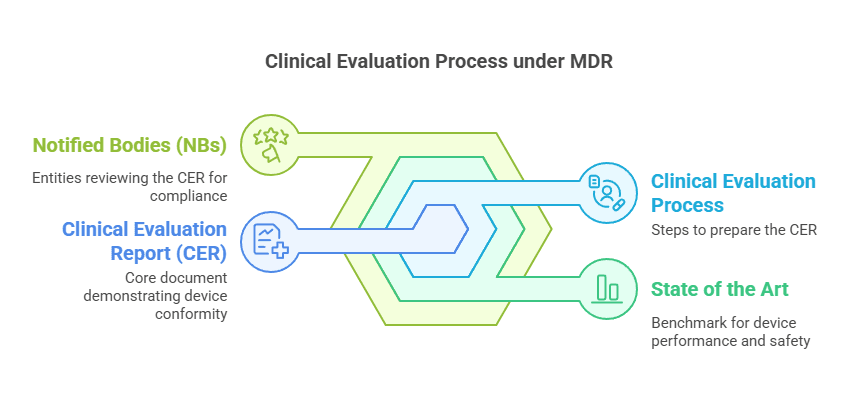
A CER is a mandatory document under MDR 2017/745 that demonstrates the safety and performance of a medical device through systematic analysis of clinical data. It must be updated throughout the device lifecycle based on PMCF findings.
How often should the CER be updated?
The CER should be updated whenever significant new clinical data becomes available, after PMCF activities, when there are changes to the device or intended purpose, and at minimum during annual reviews as part of post-market surveillance.
What causes CER rejection by Notified Bodies?
Common reasons include inadequate equivalence demonstration, insufficient clinical data for claims, poorly structured SOTA analysis, missing gap analysis, and lack of clear benefit-risk determination. Structure and logical flow are as important as the data itself.
Which MDCG guidance documents are most relevant for clinical evaluation?
Key documents include MDCG 2020-5 (Equivalence), MDCG 2020-6 (Sufficient Clinical Evidence), MDCG 2020-13 (CEAR Template), MDCG 2020-7 (PMCF Plan), and MDCG 2020-8 (PMCF Evaluation Report). MDCG 2020-7, MDCG 2020-8
Need Expert Help with Your Clinical Evaluation?
Get personalized guidance on MDR compliance, CER writing, and Notified Body preparation.
✌
Peace, Hatem
Your Clinical Evaluation Partner
Follow me for more insights and practical advice.
– MDR 2017/745 Article 61(11), Article 86, Annex XIV Part A
– MDCG 2020-7 (Post-Market Clinical Follow-up)
– MDCG 2020-8 (Post-Market Surveillance)
Deepen Your Knowledge
Read Complete Guide to Clinical Evaluation under EU MDR for a comprehensive overview of clinical evaluation under EU MDR 2017/745.