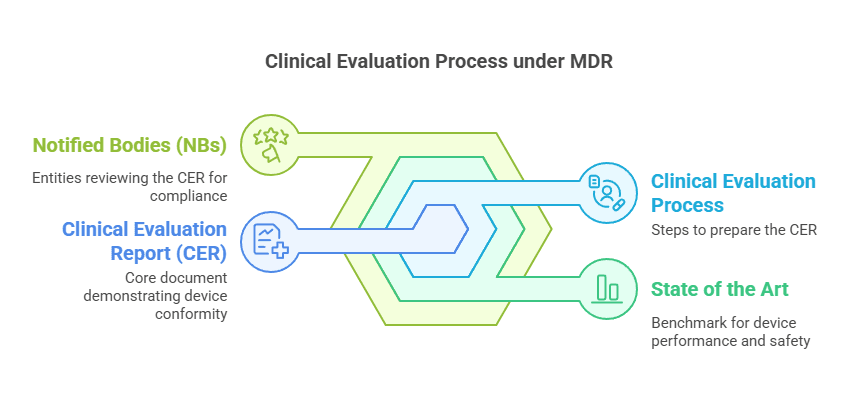
The clinical expert qualification trap – credentials reviewers verify

Last month I reviewed a CER that was rejected because the clinical expert’s CV listed ‘extensive medical device experience’ but contained no proof of clinical practice in the relevant specialty. The expert had published articles. Had attended conferences. Had even participated in previous evaluations. None of it mattered. The Notified Body asked one question: Where is the evidence of clinical competence in the intended medical domain?
In This Article
This happens more often than it should. Companies assume that a clinical expert’s general medical credentials are sufficient. They focus on academic titles, years of experience, or involvement in other device evaluations. But when the Technical Documentation is reviewed, the expert’s qualifications are assessed against a specific and narrow standard.
The question is not whether the expert is qualified in general. The question is whether they can credibly assess clinical data for this specific device, in this specific indication, for this specific patient population.
And that question is harder to answer than most people realize.
What the MDR Actually Requires
MDR Article 61(2) states that clinical evaluation must be performed in a methodologically sound manner based on (among other things) critical evaluation of relevant scientific literature and, where applicable, clinical investigation data. The evaluation shall be performed by persons with appropriate qualifications.
That last phrase is critical: appropriate qualifications.
Not impressive qualifications. Not extensive qualifications. Appropriate qualifications.
MDCG 2020-13 on clinical evaluation clarifies that clinical experts must have relevant clinical expertise in the specific medical field addressed by the device. This is not a loose requirement. It means direct clinical knowledge of the conditions being treated, the patient population being targeted, and the clinical context in which the device will be used.
The MDR does not accept generic medical expertise. The clinical expert must demonstrate specific and current competence in the relevant clinical domain.
This requirement applies whether the expert is writing the CER, reviewing it, or signing off on it as the responsible clinician.
Yet many companies still appoint clinical experts based on availability, professional relationships, or general qualifications without verifying the match between the expert’s clinical background and the device’s intended use.
What Reviewers Actually Verify
When a Notified Body or Competent Authority reviews a CER, they do not accept the clinical expert’s qualifications on trust. They verify them. And they verify them against the device’s specific claims.
Here is what they check.
1. Clinical Practice in the Relevant Specialty
The expert must have practiced clinically in the specialty that corresponds to the device’s intended use. A cardiologist cannot credibly evaluate a wound dressing. An orthopedic surgeon cannot assess a glucose monitoring system. This sounds obvious, but I have seen it happen.
What counts as practice? Direct patient care. Diagnosis. Treatment. Clinical decision-making in the relevant field. Teaching or research alone is not enough unless it directly involves clinical application of the relevant procedures or treatments.
Reviewers look for evidence in the CV. They look for positions held, departments worked in, procedures performed, patient populations treated.
If the CV does not make this clear, the expert’s qualifications are questioned.
2. Currency of Clinical Knowledge
Clinical practice must be current or recent. A physician who practiced cardiology twenty years ago but has spent the last two decades in administrative or academic roles without clinical exposure is not considered clinically current.
Currency matters because medical practice evolves. Diagnostic criteria change. Treatment standards shift. Patient populations and comorbidities differ from what they were even five years ago.
Reviewers expect evidence that the expert is engaged with contemporary clinical practice. This can be demonstrated through active clinical roles, continued professional development in the relevant field, or participation in clinical research involving current patient populations.
CVs that list publications and academic titles but provide no evidence of active clinical practice in the last five years. Reviewers reject these because they do not demonstrate current clinical competence.
3. Knowledge of State of the Art
The clinical expert must be familiar with current clinical management of the condition or disease the device addresses. This includes standard diagnostic and therapeutic approaches, guideline recommendations, and commonly used alternative treatments.
This is not abstract knowledge. It is the knowledge that comes from direct involvement in clinical decisions. It is the difference between knowing that a treatment exists and knowing when it is indicated, how it fails, and what considerations influence its use.
Reviewers assess this through the CER itself. They look at how the expert evaluates clinical data. They examine the discussion of clinical context. They assess whether the expert understands how the device fits into existing clinical practice.
If the evaluation reads like a literature summary without clinical interpretation, it signals that the expert lacks real-world familiarity with the clinical environment.
4. Understanding of the Device’s Clinical Application
The expert must understand not just the clinical condition but how the device is intended to be used. This includes the procedure, the clinical setting, the patient selection criteria, the interpretation of results, and the clinical decision-making that follows.
For diagnostic devices, the expert must understand the diagnostic pathway. For therapeutic devices, the expert must understand the treatment protocol. For monitoring devices, the expert must understand the clinical significance of the data generated.
This is where generalists fail. A physician with broad medical knowledge but no direct experience with the type of device or procedure cannot provide the clinical judgment needed to evaluate safety and performance.
Reviewers expect the CER to demonstrate this understanding. If the clinical analysis is generic, superficial, or disconnected from real clinical workflows, the expert’s qualifications are questioned.
The Documentation Problem
Even when a company appoints a truly qualified clinical expert, the qualifications are often poorly documented.
The CV is the primary evidence. And most CVs are written for academic or professional purposes, not for regulatory assessment.
They list positions, publications, conference presentations, and professional memberships. But they do not clearly show clinical practice in the relevant domain.
A CV that says ‘Senior Consultant in Internal Medicine’ does not tell the reviewer whether the expert has experience with cardiovascular monitoring, diabetes management, or respiratory disease. A CV that lists ten years in a hospital department does not clarify whether the expert performed procedures, managed patients, or supervised trainees.
Reviewers need specificity. They need to see that the expert has clinical experience directly relevant to the device’s indication.
The CV submitted with the CER must explicitly document clinical experience in the device’s specific indication. Vague descriptions and academic achievements are not sufficient.
This means the CV should include clear descriptions of clinical roles, patient populations treated, procedures performed, and clinical settings worked in. It should specify the period of active clinical practice and demonstrate current or recent involvement in the relevant field.
If the expert’s qualifications are borderline or require interpretation, the Notified Body will ask for clarification. This delays the review. And if the clarification is insufficient, the expert is rejected and a new one must be appointed.
What Happens When Qualifications Are Insufficient
When a Notified Body concludes that the clinical expert does not meet the requirements, the consequences are direct.
The CER is rejected. The Technical Documentation is incomplete. Certification is delayed.
The company must appoint a new clinical expert with appropriate qualifications. The CER may need to be rewritten or substantially revised to reflect the new expert’s input. The entire review timeline is extended.
But the problem goes deeper than delay.
If the clinical expert’s qualifications are insufficient, the credibility of the entire clinical evaluation is undermined. Reviewers question whether the clinical analysis is valid. They examine the literature appraisal more critically. They scrutinize the clinical conclusions more carefully.
The burden of proof shifts. The company must demonstrate that the evaluation is sound despite the questionable qualifications of the expert who performed it.
This is not a theoretical risk. I have seen CERs that were technically well-written but rejected because the clinical expert could not justify their involvement in the specific clinical domain.
How to Verify Qualifications Before Submission
The solution is straightforward. Verify the clinical expert’s qualifications before appointing them. And document those qualifications clearly.
Start by defining the specific clinical domain relevant to the device. Not the general medical field. The specific indication, patient population, clinical setting, and procedure.
Then assess whether the candidate expert has direct clinical experience in that domain. Look for evidence of patient care, clinical decision-making, and familiarity with current clinical practice.
Review the expert’s CV critically. Ask whether a Notified Body reviewer would be able to confirm the expert’s qualifications from the CV alone. If not, request clarification or additional documentation.
Consider asking the expert to provide a statement of qualifications that explicitly addresses their clinical experience in the relevant domain. This statement should describe their clinical roles, the patient populations they have treated, and their familiarity with current clinical management of the condition.
Finally, review the CER itself as evidence of the expert’s competence. Does the clinical analysis demonstrate real-world clinical judgment? Does it reflect an understanding of how the device fits into clinical practice? Does it show familiarity with current treatment standards?
If the CER reads like a literature review without clinical interpretation, the expert may not have the necessary clinical depth.
Companies assume that any physician in the general specialty is qualified. They do not verify that the expert has specific experience with the device’s indication or clinical application. This leads to qualification challenges during review.
The Qualification Standard Is Not Negotiable
Some companies try to argue that their expert is qualified because of academic standing, research output, or involvement in other device evaluations. These arguments are rarely successful.
The MDR requires clinical competence in the specific domain. This is a functional requirement, not an honorific one.
A professor of medicine with no direct clinical experience in the relevant field is less qualified than a practicing clinician who treats the condition daily. A researcher who publishes on medical devices but does not manage patients is not a clinical expert in the regulatory sense.
Notified Bodies and Competent Authorities apply this standard consistently. They do not accept substitutes for clinical practice. They do not accept general expertise in place of specific competence.
The standard is clear. The expert must have clinical knowledge of the specific condition, patient population, and clinical context relevant to the device.
If the expert does not meet that standard, they are not appropriate under the MDR.
Final Considerations
The clinical expert’s qualifications are not a procedural detail. They are the foundation of the clinical evaluation’s credibility.
Reviewers assess the expert’s qualifications because they need assurance that the clinical analysis is based on real clinical judgment. They need confidence that the conclusions reflect an understanding of clinical practice, not just literature review.
This means the expert’s qualifications must be specific, current, and clearly documented.
Most qualification deficiencies are avoidable. They result from assumptions, incomplete verification, or reliance on general credentials without confirming the match to the device’s indication.
The solution is to assess qualifications rigorously before submission and to document them clearly in the Technical Documentation.
Because once the Notified Body questions the expert’s qualifications, the entire clinical evaluation is at risk.
– Regulation (EU) 2017/745 (MDR) Article 61(2)
– MDCG 2020-13: Clinical evaluation assessment of medical devices
Peace,
Hatem
Clinical Evaluation Expert for Medical Devices
Follow me for more insights and practical advice.
Frequently Asked Questions
What is a Clinical Evaluation Report (CER)?
A CER is a mandatory document under MDR 2017/745 that demonstrates the safety and performance of a medical device through systematic analysis of clinical data. It must be updated throughout the device lifecycle based on PMCF findings.
How often should the CER be updated?
The CER should be updated whenever significant new clinical data becomes available, after PMCF activities, when there are changes to the device or intended purpose, and at minimum during annual reviews as part of post-market surveillance.
What causes CER rejection by Notified Bodies?
Common reasons include inadequate equivalence demonstration, insufficient clinical data for claims, poorly structured SOTA analysis, missing gap analysis, and lack of clear benefit-risk determination. Structure and logical flow are as important as the data itself.
Which MDCG guidance documents are most relevant for clinical evaluation?
Key documents include MDCG 2020-5 (Equivalence), MDCG 2020-6 (Sufficient Clinical Evidence), MDCG 2020-13 (CEAR Template), MDCG 2020-7 (PMCF Plan), and MDCG 2020-8 (PMCF Evaluation Report).
Need Expert Help with Your Clinical Evaluation?
Get personalized guidance on MDR compliance, CER writing, and Notified Body preparation.
✌
Peace, Hatem
Your Clinical Evaluation Partner
Follow me for more insights and practical advice.
Deepen Your Knowledge
Read Complete Guide to Clinical Evaluation under EU MDR for a comprehensive overview of clinical evaluation under EU MDR 2017/745.