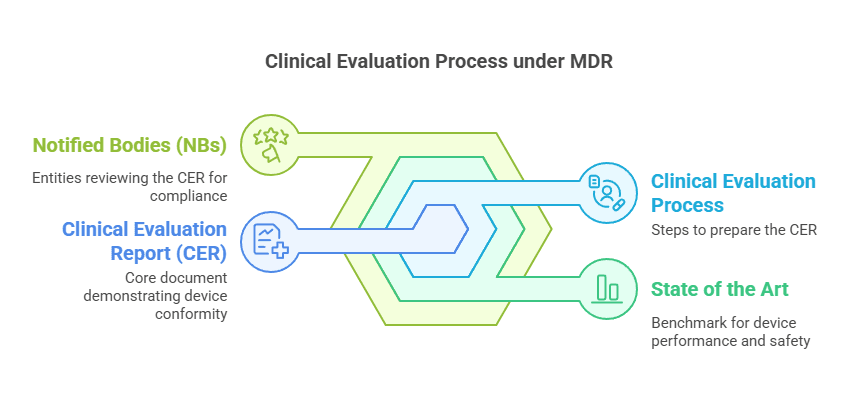
SOTA analysis: What reviewers need vs. what they usually get

I’ve reviewed clinical evaluation reports where the SOTA section runs 40 pages but says almost nothing about clinical performance. The file gets a deficiency. The manufacturer adds another 20 pages of literature summaries. The deficiency remains. Here’s why.
The State of the Art analysis is not a literature review exercise. It’s not about demonstrating you can search databases or summarize papers.
It’s a structured analysis meant to demonstrate that your device meets current knowledge and technical performance. That you understand what’s available, what’s accepted, and where your device sits in that landscape.
Most SOTA sections fail because they answer the wrong question.
What the regulation actually requires
MDR Article 61(1) states that manufacturers must demonstrate conformity with general safety and performance requirements. Annex I, Chapter II specifically requires that devices achieve the performance intended by the manufacturer and are designed to achieve appropriate performance in view of the generally acknowledged state of the art.
MDCG 2020-5, the guidance on clinical evaluation, clarifies this further. The SOTA analysis must demonstrate that the device performs as well as or better than alternative treatment options currently accepted in clinical practice.
Notice what’s not mentioned: comprehensive literature collection. Systematic summaries of every paper published.
The requirement is about demonstrating appropriate clinical performance relative to what exists and what’s known.
Reviewers want to see performance comparison and clinical context, not literature volume. The question is always: Does this device meet current standards of care?
Yet most SOTA sections read like academic exercises. They collect papers. They summarize findings. They create tables of study characteristics.
But they don’t analyze performance.
The structure that actually works
A functional SOTA analysis starts with the clinical condition, not with the literature search.
What is the medical condition being addressed? What are the relevant patient populations? What are the severity ranges, progression patterns, and clinical outcomes that matter?
This context sets the frame for everything that follows.
Then you define the alternatives. What are the current treatment options? What technologies exist? What approaches are accepted in clinical guidelines?
This is not a marketing comparison. It’s a clinical reality check.
For a surgical implant, the alternatives might include other implant designs, non-surgical management, or different surgical techniques. For a diagnostic device, it might be existing tests, imaging modalities, or clinical assessment methods.
Once alternatives are defined, you establish performance benchmarks. What are the expected clinical outcomes with these alternatives? What does current literature report for safety, effectiveness, and key performance parameters?
This is where literature enters, but in a targeted way.
You’re not collecting every paper on the condition. You’re identifying what performance is considered acceptable, what complication rates are expected, what effectiveness thresholds exist.
SOTA sections that list alternative devices without analyzing their clinical performance or explaining how they compare to the subject device. Reviewers issue deficiencies asking:
Frequently Asked Questions
What is a Clinical Evaluation Report (CER)?
A CER is a mandatory document under MDR 2017/745 that demonstrates the safety and performance of a medical device through systematic analysis of clinical data. It must be updated throughout the device lifecycle based on PMCF findings.
How often should the CER be updated?
The CER should be updated whenever significant new clinical data becomes available, after PMCF activities, when there are changes to the device or intended purpose, and at minimum during annual reviews as part of post-market surveillance.
What causes CER rejection by Notified Bodies?
Common reasons include inadequate equivalence demonstration, insufficient clinical data for claims, poorly structured SOTA analysis, missing gap analysis, and lack of clear benefit-risk determination. Structure and logical flow are as important as the data itself.
Which MDCG guidance documents are most relevant for clinical evaluation?
Key documents include MDCG 2020-5 (Equivalence), MDCG 2020-6 (Sufficient Clinical Evidence), MDCG 2020-13 (CEAR Template), MDCG 2020-7 (PMCF Plan), and MDCG 2020-8 (PMCF Evaluation Report).
Need Expert Help with Your Clinical Evaluation?
Get personalized guidance on MDR compliance, CER writing, and Notified Body preparation.
✌
Peace, Hatem
Your Clinical Evaluation Partner
Follow me for more insights and practical advice.
Related Resources
Read our complete guide to SOTA analysis under EU MDR: State of the Art (SOTA) Analysis under EU MDR
Or explore Complete Guide to Clinical Evaluation under EU MDR