Legacy devices after Brexit: when transition ends abruptly

A manufacturer brought me their CE-marked device documentation in early 2024. They assumed their UK market access was automatic. The device had been on the market since 2019 under MDD. But their clinical evaluation stopped at the point of CE certification. No structured post-market follow-up. No periodic updates. When I asked about their plan for UKCA transition, they said they were waiting for clarity. That clarity never came in the form they expected.
Brexit created a regulatory divide that many manufacturers still underestimate. The UK is no longer part of the EU regulatory system. That means CE marking alone does not grant market access in Great Britain. The UKCA marking became mandatory for new devices placed on the GB market. But the real complexity lies with legacy devices already in circulation before the transition.
These are not new products. They were legally placed under the old rules. Yet they must now meet evolving expectations that were not in place when they were first cleared. This creates a documentation gap that becomes visible only when manufacturers attempt to renew or extend their market presence.
I see this repeatedly in files that assume grandfathering means exemption. It does not. Grandfathering provides time. It does not suspend the need for clinical evidence that supports continued safety and performance.
What the UK MDR 2002 transition period actually meant
The UK Medical Devices Regulations 2002, as amended post-Brexit, allowed for a transition period. Devices with valid CE marking under the old EU directives could continue to be placed on the GB market until specific deadlines. These deadlines varied by device class and risk level.
But this transition was never intended as a permanent state. It was a bridge. And bridges have endpoints.
The assumption I encounter most often is that legacy status protects a device indefinitely. It does not. Once the transition period closes, a device without UKCA marking and updated technical documentation cannot legally be placed on the GB market for the first time. Devices already in the supply chain or already with end users are not recalled. But new placements require compliance with current rules.
Manufacturers interpret transition deadlines as the moment they must
Frequently Asked Questions
What is a Clinical Evaluation Report (CER)?
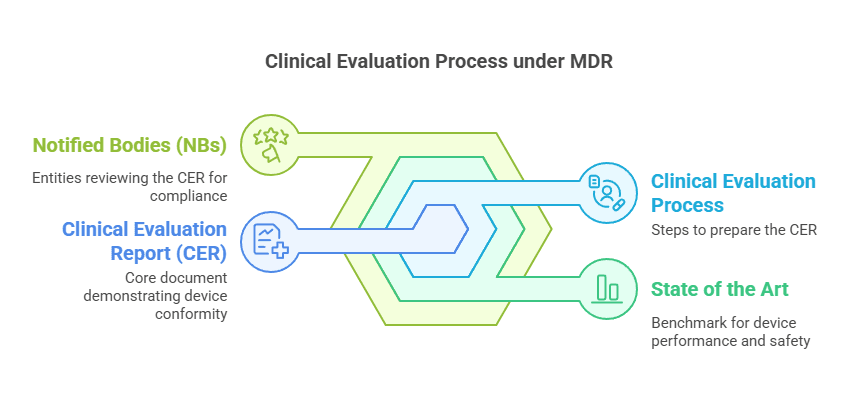
A CER is a mandatory document under MDR 2017/745 that demonstrates the safety and performance of a medical device through systematic analysis of clinical data. It must be updated throughout the device lifecycle based on PMCF findings.
How often should the CER be updated?
The CER should be updated whenever significant new clinical data becomes available, after PMCF activities, when there are changes to the device or intended purpose, and at minimum during annual reviews as part of post-market surveillance.
What causes CER rejection by Notified Bodies?
Common reasons include inadequate equivalence demonstration, insufficient clinical data for claims, poorly structured SOTA analysis, missing gap analysis, and lack of clear benefit-risk determination. Structure and logical flow are as important as the data itself.
Which MDCG guidance documents are most relevant for clinical evaluation?
Key documents include MDCG 2020-5 (Equivalence), MDCG 2020-6 (Sufficient Clinical Evidence), MDCG 2020-13 (CEAR Template), MDCG 2020-7 (PMCF Plan), and MDCG 2020-8 (PMCF Evaluation Report). UK MDR 2002
Need Expert Help with Your Clinical Evaluation?
Get personalized guidance on MDR compliance, CER writing, and Notified Body preparation.
✌
Peace, Hatem
Your Clinical Evaluation Partner
Follow me for more insights and practical advice.
Deepen Your Knowledge
Read Complete Guide to Clinical Evaluation under EU MDR for a comprehensive overview of clinical evaluation under EU MDR 2017/745.