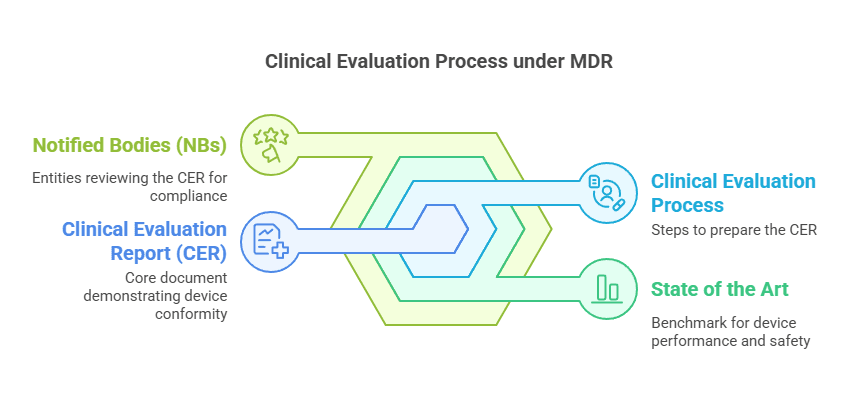
Class IIa rigor: neither minimal nor identical to Class III

I reviewed a CER last month where a manufacturer applied the same evidence depth for a Class IIa suture as they would for a Class III cardiac implant. The Notified Body sent fourteen pages of deficiencies. At the other extreme, I see Class IIa submissions that read like literature reviews with no critical appraisal. Both fail. The problem is not laziness. The problem is misunderstanding what appropriate rigor actually means for moderate-risk devices.
In This Article
Class IIa devices occupy a peculiar space in the MDR framework. They require clinical evaluation reports under Annex XIV, but the level of clinical evidence needed sits somewhere between the minimal requirements of Class I and the extensive datasets expected for Class III.
This middle ground creates confusion. Manufacturers either over-engineer their clinical evaluations, wasting resources and delaying submissions, or they under-invest, assuming that Class IIa means the bar is low. Neither approach survives review.
What the regulation actually requires
MDR Article 61(1) applies to all device classes. It states that manufacturers must demonstrate conformity through clinical evaluation based on clinical data. The regulation does not say Class IIa devices need less evidence. It says the evidence must be appropriate to the risk profile and characteristics of the device.
Annex XIV Part A defines the scope: clinical evaluation must be methodologically sound, based on critical appraisal, and cover safety and performance under normal conditions of use. That applies equally to Class IIa, Class IIb, and Class III.
The difference is in how much data is needed to satisfy those requirements, not whether the requirements apply.
Appropriate rigor for Class IIa means the evaluation process is complete, not that the evidence quantity is reduced. You still need critical appraisal, you still need a systematic literature search, and you still need gap analysis. What changes is the acceptable level of evidence to close those gaps.
MDCG 2020-5 on clinical evaluation clarifies that the depth of analysis should match the risk class, the novelty of the device, and the availability of equivalent device data. Class IIa devices are moderate risk. If your device has well-established technology and clinical use, the evidence burden is lower. If your device introduces new materials, new mechanisms, or claims that are not widely supported, the evidence burden increases.
Where manufacturers go wrong
The most common mistake is treating Class IIa as if it means optional rigor. I see CERs where the literature search returns forty papers, the manufacturer lists all forty titles, provides no critical appraisal, and concludes that safety and performance are demonstrated.
That is not a clinical evaluation. That is a bibliography.
A Notified Body reviewer will immediately flag the absence of appraisal criteria, the lack of data extraction, and the missing analysis of clinical endpoints. The fact that the device is Class IIa does not excuse these omissions.
On the other side, I see manufacturers who treat every Class IIa device as if it were a high-risk implant. They commission prospective clinical investigations when retrospective data would suffice. They conduct equivalence assessments with forensic-level detail when the device is essentially identical to predicate devices with decades of safe use.
This over-engineering delays market access and consumes budget that could be used for post-market surveillance or usability testing.
Class IIa CERs that include literature search results but no critical appraisal, no weighting of evidence, and no analysis of clinical endpoints relevant to the device. Reviewers will reject this regardless of device class.
What appropriate rigor looks like in practice
For a Class IIa device with established technology, appropriate rigor means you conduct a systematic literature search, apply appraisal criteria to the retrieved studies, extract relevant data, and analyze whether the pooled evidence supports your safety and performance claims.
You do not need randomized controlled trials unless your claims require them. You do not need original clinical investigations unless the existing data contains critical gaps that cannot be addressed through equivalence or other means.
But you do need to show that you evaluated the evidence systematically and critically. That means documenting your search strategy, inclusion and exclusion criteria, and the rationale for accepting or rejecting each study.
For example, if you are evaluating a wound dressing with a well-known antimicrobial agent, you search for clinical studies on that agent in wound care. You retrieve thirty studies. You screen them for relevance to your intended use, patient population, and device characteristics. You critically appraise the methodological quality of the included studies. You extract safety and performance data. You analyze whether that data supports your claims about infection reduction, healing time, and adverse events.
That process is appropriate for Class IIa. It is systematic, it is critical, and it is proportionate to the risk.
When equivalence is acceptable
MDR Annex XIV Part A allows clinical evaluation based on equivalence to another device for which clinical data exists, provided you demonstrate technical and clinical equivalence.
Class IIa devices are often good candidates for equivalence-based evaluation, especially when the technology is well-established. But equivalence does not mean you skip the evaluation. It means the clinical data comes from another device instead of your own investigations.
You still need to demonstrate that the devices are equivalent in design, materials, biological characteristics, and clinical performance. You still need to show that the predicate device has sufficient clinical data. And you still need to analyze whether that data applies to your device’s intended use and claims.
I reviewed a Class IIa surgical retractor CER where the manufacturer claimed equivalence to a predicate device but provided no analysis of the materials, no comparison of the design features, and no discussion of whether the clinical data from the predicate covered the same surgical procedures.
The Notified Body rejected the equivalence claim. Not because equivalence is inappropriate for Class IIa, but because the demonstration of equivalence was incomplete.
Equivalence is a valid pathway for Class IIa devices, but it must be demonstrated with the same rigor as any other evaluation method. That means documented comparison, not assertion.
The role of PMCF in Class IIa
Article 61(11) requires PMCF for all device classes. For Class IIa devices, PMCF is not optional, but the plan can be less intensive than what is expected for high-risk devices.
Appropriate PMCF for Class IIa might include routine collection of complaint data, periodic literature searches, and targeted surveys or registry participation. It does not necessarily require ongoing clinical studies unless your device has specific risks or novel claims that warrant active surveillance.
What matters is that the PMCF plan addresses the residual uncertainties identified in your clinical evaluation. If your CER identifies gaps in long-term performance data, your PMCF plan should describe how you will collect that data post-market. If your literature search found limited evidence on a specific patient subgroup, your PMCF should target that subgroup.
The rigor of your PMCF plan should match the risk profile and the evidence gaps. For most Class IIa devices, passive surveillance combined with periodic literature review is sufficient. For devices with new features or unproven claims, active data collection becomes necessary.
What reviewers actually check
When a Notified Body or competent authority reviews a Class IIa CER, they check whether you followed a systematic process. They look for a documented search strategy, explicit appraisal criteria, data extraction tables, and analysis of clinical endpoints.
They check whether your conclusions are supported by the data. If you claim low complication rates, they expect to see pooled complication data from the literature or from your own studies. If you claim equivalence, they expect to see a detailed comparison demonstrating technical and clinical similarity.
They check whether your PMCF plan addresses the gaps. If your pre-market evidence is limited to short-term data, they expect your PMCF to collect long-term data.
What they do not accept is vague language, unsupported claims, or the assumption that Class IIa allows shortcuts. The rigor of the process must be complete, even if the volume of data is smaller than what Class III devices require.
Class IIa CERs that state conclusions without showing the analysis. Reviewers reject CERs that claim safety and performance are demonstrated but provide no data extraction, no appraisal weighting, and no endpoint-specific analysis.
Calibrating effort to risk and novelty
The appropriate level of rigor for Class IIa depends on two factors: the specific risks of the device and the novelty of the technology or claims.
A Class IIa device with well-established technology, extensive predicate data, and no novel claims requires less original clinical data but still requires a complete evaluation process. A Class IIa device with new materials, new mechanisms, or claims that extend beyond established use requires more robust evidence, possibly including original clinical investigations.
For example, a non-absorbable suture made from a standard polymer with decades of safe use can rely heavily on equivalence and published literature. The rigor is in demonstrating equivalence and critically appraising the literature, not in generating new clinical studies.
A Class IIa wound dressing that claims to accelerate healing through a novel mechanism requires clinical data specific to that mechanism. Equivalence to standard dressings will not suffice because the claim is novel. The rigor here increases because the evidence must address the specific claim.
This calibration is what MDCG 2020-5 refers to when it says the evaluation should be proportionate. Proportionate does not mean reduced. It means appropriate to the risk, the novelty, and the available data.
Final perspective
Class IIa devices are moderate risk. The clinical evaluation must be proportionate to that risk. That means the process must be complete and systematic, but the evidence required to close gaps can be less extensive than what high-risk devices demand.
The mistake is thinking that Class IIa allows you to skip steps. It does not. You still need systematic search, critical appraisal, gap analysis, and PMCF planning. What changes is the acceptable level of evidence to demonstrate safety and performance, not the rigor of the evaluation process itself.
The key is understanding what your Notified Body or competent authority will check. They will check your process. They will check whether your conclusions follow from your data. They will check whether your PMCF addresses the gaps. If any of those elements is missing, the device class will not protect you from deficiencies.
Appropriate rigor for Class IIa is neither minimal nor excessive. It is complete, proportionate, and defensible.
Peace,
Hatem
Clinical Evaluation Expert for Medical Devices
Follow me for more insights and practical advice.
Frequently Asked Questions
What is a Clinical Evaluation Report (CER)?
A CER is a mandatory document under MDR 2017/745 that demonstrates the safety and performance of a medical device through systematic analysis of clinical data. It must be updated throughout the device lifecycle based on PMCF findings.
How often should the CER be updated?
The CER should be updated whenever significant new clinical data becomes available, after PMCF activities, when there are changes to the device or intended purpose, and at minimum during annual reviews as part of post-market surveillance.
What causes CER rejection by Notified Bodies?
Common reasons include inadequate equivalence demonstration, insufficient clinical data for claims, poorly structured SOTA analysis, missing gap analysis, and lack of clear benefit-risk determination. Structure and logical flow are as important as the data itself.
Which MDCG guidance documents are most relevant for clinical evaluation?
Key documents include MDCG 2020-5 (Equivalence), MDCG 2020-6 (Sufficient Clinical Evidence), MDCG 2020-13 (CEAR Template), MDCG 2020-7 (PMCF Plan), and MDCG 2020-8 (PMCF Evaluation Report).
Need Expert Help with Your Clinical Evaluation?
Get personalized guidance on MDR compliance, CER writing, and Notified Body preparation.
✌
Peace, Hatem
Your Clinical Evaluation Partner
Follow me for more insights and practical advice.
– MDR 2017/745 Article 61 (Clinical evaluation)
– MDR 2017/745 Annex XIV (Clinical evaluation and post-market clinical follow-up)
– MDCG 2020-5 Clinical evaluation assessment report template
– MDCG 2020-6 Regulation (EU) 2017/745: Sufficient clinical evidence for legacy devices
Deepen Your Knowledge
Read Complete Guide to Clinical Evaluation under EU MDR for a comprehensive overview of clinical evaluation under EU MDR 2017/745.