App stores don’t make your device a consumer product

A manufacturer distributes a CE-marked diagnostic app through Apple’s App Store. The clinical evaluation references clinical data from hospital-controlled studies. The Notified Body raises a major non-conformity: the evidence doesn’t reflect actual use conditions. The app store changed everything about intended use, access control, and user competence. But the clinical file never addressed it.
This pattern appears repeatedly in SaMD submissions. The clinical evaluation is built for one distribution model, and the manufacturer switches to a consumer app store without updating the clinical rationale.
It’s not just a regulatory technicality. The distribution channel fundamentally alters risk profile, user behavior, and the validity of your clinical evidence base.
Let’s walk through what changes when your software moves to an app store, and why your clinical file must address it explicitly.
The clinical evaluation was built for a different device
Most SaMD clinical evaluations start with literature and clinical data generated in controlled settings. Hospital environments. Supervised use. Professional users.
When you distribute through an app store, you’ve changed the device. Not just how it’s delivered, but who uses it, how they use it, and what happens when something goes wrong.
The MDR doesn’t say
Frequently Asked Questions
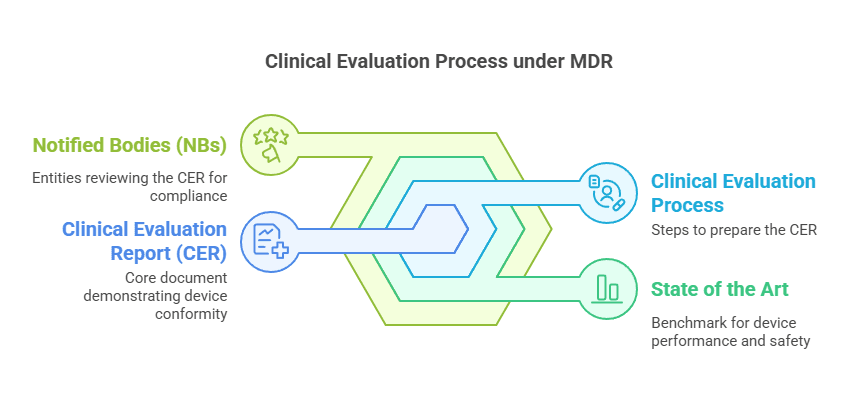
What is a Clinical Evaluation Report (CER)?
A CER is a mandatory document under MDR 2017/745 that demonstrates the safety and performance of a medical device through systematic analysis of clinical data. It must be updated throughout the device lifecycle based on PMCF findings.
How often should the CER be updated?
The CER should be updated whenever significant new clinical data becomes available, after PMCF activities, when there are changes to the device or intended purpose, and at minimum during annual reviews as part of post-market surveillance.
What causes CER rejection by Notified Bodies?
Common reasons include inadequate equivalence demonstration, insufficient clinical data for claims, poorly structured SOTA analysis, missing gap analysis, and lack of clear benefit-risk determination. Structure and logical flow are as important as the data itself.
Which MDCG guidance documents are most relevant for clinical evaluation?
Key documents include MDCG 2020-5 (Equivalence), MDCG 2020-6 (Sufficient Clinical Evidence), MDCG 2020-13 (CEAR Template), MDCG 2020-7 (PMCF Plan), and MDCG 2020-8 (PMCF Evaluation Report). MDCG 2020-1
Need Expert Help with Your Clinical Evaluation?
Get personalized guidance on MDR compliance, CER writing, and Notified Body preparation.
✌
Peace, Hatem
Your Clinical Evaluation Partner
Follow me for more insights and practical advice.
Why App Store Distribution Does Not Change Device Classification
Under MDR 2017/745 and MDCG 2019-11, software that meets the definition of a medical device remains a medical device regardless of its distribution channel. The fact that software is available on the Apple App Store or Google Play does not reclassify it as a consumer product or exempt it from regulatory requirements. The intended purpose, not the distribution method, determines whether software qualifies as a medical device under Rule 11 of Annex VIII.
Many manufacturers assume that consumer availability changes their obligations. In reality, Notified Bodies and competent authorities assess the intended purpose as stated in the Instructions for Use (IFU) and marketing materials. If the software is intended to diagnose, treat, monitor, or predict disease conditions, it falls under MDR regardless of where users download it.
Clinical Evaluation Requirements for Software as a Medical Device
Software medical devices distributed via app stores face the same clinical evaluation requirements as hardware devices. MDCG 2020-1 provides specific guidance on clinical evaluation of medical device software (MDSW). Key requirements include:
- Clinical evidence demonstrating that the software algorithm performs as intended in the target population
- Validation of the clinical association between the software output and the clinical condition
- Technical validation showing analytical performance under real-world conditions
- Post-market clinical follow-up (PMCF) to monitor ongoing safety and performance after deployment
The fact that software updates can be pushed remotely through app stores adds complexity to post-market surveillance obligations. Each significant update may require re-evaluation of clinical evidence and a potential update to the CER and PMCF plan.
Practical Steps for App Store Medical Device Compliance
If your medical device software is distributed via app stores, ensure your compliance strategy covers these critical areas. First, your app store listing description must align exactly with the intended purpose stated in your technical documentation. Any discrepancy between the app store description and the IFU can be flagged by regulators. Second, maintain control over software version management, as app stores may push updates that affect clinical performance. Third, implement a post-market surveillance system that captures user-reported issues through both the app store review system and your own complaint handling process.
Document your distribution strategy in the technical file and explain how consumer availability does not alter the device classification or intended purpose. Competent authorities in the EU have confirmed that software intended for professional use does not change classification simply because non-professionals could theoretically download it from a public app store.
Deepen Your Knowledge
Read Complete Guide to Clinical Evaluation under EU MDR for a comprehensive overview of clinical evaluation under EU MDR 2017/745.