The Vital Role of CER Consultants in Medical Device Success

Introduction
From my dual perspective as a Clinical Evaluation Specialist and a practicing Medical Doctor, I can attest that Clinical Evaluation Report (CER) consultants are indispensable in today’s ever-evolving medical device landscape. Their contribution is not only critical in fulfilling the stringent EU MDR (Medical Device Regulation) requirements but also pivotal in accelerating market access and safeguarding public health. This article dives deep into the strategic, scientific, and regulatory value CER consultants bring to the table—especially in the preparation of robust, evidence-based CERs for CE marking in the European Union.
The Role of CER Consultants in Medtech
CER consultants are the regulatory whisperers of the medical device industry. They bridge the gap between technical documentation and regulatory compliance, ensuring that all clinical data convincingly demonstrates a product’s safety, performance, and benefit-risk ratio. But what makes them truly irreplaceable?
Let’s unpack their multi-faceted role in the clinical evaluation lifecycle.
Understanding Clinical Evaluation
Clinical evaluation is an iterative process that systematically assesses a device using clinical data to validate its intended use, performance characteristics, and safety profile. It’s more than just a formality—it’s a regulatory linchpin that determines whether a medical device is fit for the European market.
Under the EU MDR, clinical evaluation is not optional. Every medical device, regardless of classification, must have a clinical evaluation report as part of its technical documentation to obtain and maintain CE marking. This report must be living—it should be regularly updated to reflect post-market data and evolving standards.
Why Clinical Evaluation is Regulatory Gold
A robust CER is the cornerstone of market access in Europe. Regulators use it to:
Ensure device safety and performance based on clinical evidence
Confirm a positive benefit-risk ratio
Evaluate equivalence claims with other devices
Monitor ongoing clinical performance post-market
Without a solid CER, the entire regulatory submission could collapse—hence, the indispensable role of CER consultants.
The CER Consultant’s Toolbox: Core Responsibilities
Staying Ahead of Regulatory Changes
CER consultants continuously monitor evolving regulations, standards (like MEDDEV 2.7/1 Rev 4 and EU MDR Annex XIV), and guidance from notified bodies. Their up-to-date knowledge ensures that no submission is outdated or non-compliant.
Conducting Literature Reviews and Data Analysis
A core aspect of CER preparation involves systematic literature reviews. Consultants search, appraise, and synthesize clinical publications to:
Justify the device’s performance
Compare with equivalent products
Fill data gaps with peer-reviewed evidence
They also analyze clinical data from pre-clinical studies, trials, registries, and post-market surveillance (PMS) reports.
Performing Risk-Benefit Analyses
Every CER must present a compelling risk-benefit narrative. Consultants evaluate clinical risks, adverse events, and known complications in light of the clinical benefits, ensuring that the latter always outweighs the former.
Crafting the Clinical Evaluation Report
Perhaps the most visible output, the CER itself is a structured, scientifically reasoned, and regulator-ready document. A well-prepared CER:
Aligns with MDR’s General Safety and Performance Requirements (GSPR)
Details clinical development history
Demonstrates scientific validity and transparency
Benefits of Hiring a CER Consultant
Expertise That Drives Precision
CER consultants bring deep domain knowledge in device types, therapeutic areas, and regulatory affairs. Their writing and analytical skills are honed through years of specialization.
Efficiency in Submission Timelines
They streamline the CER process, ensuring timelines are met without compromising quality—this is essential in the fast-paced medtech market.
Assurance of Compliance
They reduce the risk of non-conformities by aligning every component of the CER with regulatory expectations, thereby avoiding costly delays and rejections.
Choosing the Right CER Consultant
Not all consultants are created equal. Here’s what to consider:
Experience in Your Device Class: Whether it’s Class I or Class III, ensure they’ve navigated similar regulatory waters before.
Therapeutic Area Familiarity: Medical writing is nuanced; your consultant should understand the clinical context.
Track Record with Notified Bodies: Ask if they’ve successfully supported clients through NB reviews and CAPAs.
Communication Skills: Complex data must be translated into clear and regulator-friendly language.
Clinical Evaluation Report (CER): A Strategic Document
It’s easy to view the CER as a regulatory checkbox. However, it’s actually a strategic asset. It provides internal stakeholders (engineering, marketing, post-market teams) with insights on:
Product positioning against competitors
Data-driven marketing claims
Clinical trial planning
Risk management strategies
Key Components of a CER
Device Description & Intended Use
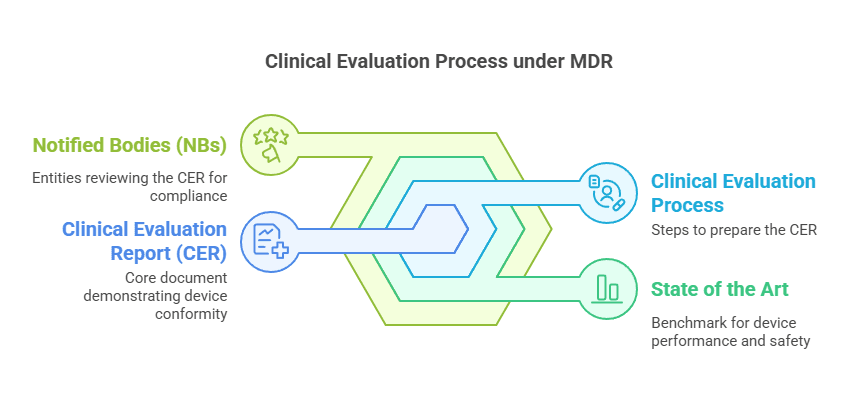
State of the Art (SOTA) Assessment
Clinical Data & Literature Review
Equivalence Justification
Clinical Performance & Safety Analysis
Post-Market Clinical Follow-Up (PMCF) Plans
How CER Consultants Stay Ahead of the Curve
Staying compliant requires staying updated. Great CER consultants often:
Attend regulatory workshops and webinars
Subscribe to MDCG guidance updates
Maintain access to scientific databases and journals
Regularly network with notified body representatives
The Future of CERs: Trends to Watch
AI in Literature Reviews
Real-World Evidence (RWE) integration
Increased scrutiny of Equivalence Claims
Stronger emphasis on PMCF data
Tighter timelines from notified bodies
Frequently Asked Questions
What is a Clinical Evaluation Report (CER)?
A CER is a comprehensive document demonstrating the clinical safety and performance of a medical device using clinical data.
Why are CER consultants necessary?
They bring regulatory expertise and ensure the CER aligns with EU MDR requirements, reducing the risk of rejection or delays.
How do CER consultants gather clinical data?
They use systematic literature reviews, clinical studies, real-world data, and post-market surveillance.
Can a manufacturer write their own CER?
Yes, but it often lacks the rigor and regulatory familiarity that professional consultants bring, increasing risk.
What are the consequences of a poor CER?
It can lead to non-compliance, delayed CE marking, and ultimately market exclusion.
How often should a CER be updated?
Typically, CERs should be updated annually or after significant changes in device use, design, or clinical data.
Final Thoughts
In the world of medical devices, clinical evaluation isn’t just another regulatory hurdle—it’s a lifeline to the market and the patients who rely on innovative technologies. CER consultants play a crucial, often underappreciated role in ensuring that this process is not only compliant but also efficient, defensible, and strategically valuable.
Their expertise, adaptability, and regulatory foresight are invaluable for manufacturers navigating the complex maze of the EU MDR.
PS: For more information, subscribe to my newsletter and get access to exclusive content, private insights, and expert guidance on MDR compliance and CE marking: Subscribe Here
✌️ Peace,
Hatem Rabeh, MD, MSc Ing
Your Clinical Evaluation Expert & Partner
Follow me for more insights and practical advice!